
Portugal has become one of Europe’s fastest-growing tech hubs, with Lisbon hosting engineering offices for Google, Cloudflare, and Farfetch, and Porto anchoring a thriving startup scene around companies like OutSystems and Feedzai. For foreign developers and IT professionals, that growth translates into real hiring demand, dedicated visa pathways, and a lower cost of living than most Western European tech capitals. Here’s what these jobs actually pay, who’s hiring, and exactly how to apply.
[Image placeholder 1 — alt text: “Software developer working at a tech office in Lisbon, Portugal”]
Why Portugal’s Tech Sector Is Attracting Foreign Talent
Lisbon hosts the annual Web Summit, one of the world’s largest technology conferences, and has drawn engineering offices from major global companies alongside a growing base of home-grown tech firms. Portugal-founded companies such as Talkdesk, Feedzai, Farfetch, and Unbabel now operate globally, while Porto has built its own momentum around OutSystems and Feedzai’s engineering hub.
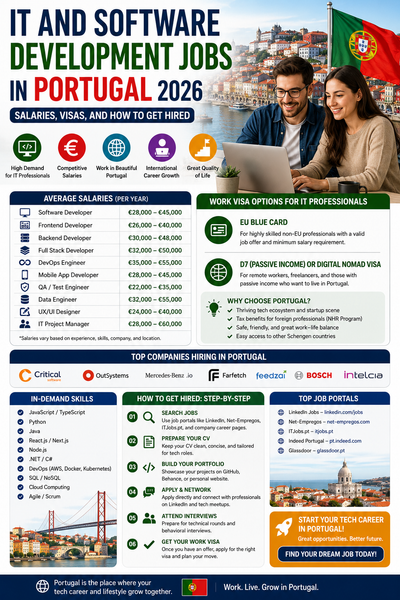
The appeal isn’t just the jobs themselves. Portugal offers over 300 days of sunshine a year, a relaxed lifestyle, and a cost of living significantly below London, Amsterdam, or Paris — a one-bedroom apartment in central Lisbon typically runs €1,100–€1,600 per month, well under equivalent Western European tech capitals. That combination has made the country a magnet for both relocating engineers and remote workers who base themselves there while working for employers abroad.
Types of IT and Software Jobs Available in Portugal
1. Software Engineer / Developer
The core role across backend, frontend, and full-stack positions, with strong demand at both traditional Portuguese employers and international offices based in Lisbon and Porto.
2. Cloud and Infrastructure Engineer
Growing steadily as companies like Cloudflare expand their Lisbon operations, with demand centered on cloud platforms, DevOps, and security.
3. Data Engineer / Data Scientist
In-demand at fintech and e-commerce companies, particularly at firms handling large-scale platforms like Farfetch.
4. QA / Test Engineer
A common entry point for newer developers, with steady demand across both product companies and outsourcing firms.
5. IT Support / Help Desk
Lower barrier to entry than development roles, often combined with multilingual customer support responsibilities for international companies.
6. Remote Software Engineer
A distinct and fast-growing category: many engineers based in Portugal work for U.S. or Northern European employers rather than Portuguese companies, drawn by the country’s lifestyle and cost advantages rather than local pay scales.
[Image placeholder 2 — alt text: “Remote software engineer working from a co-working space in Porto”]
How Much Do IT and Software Jobs Pay in Portugal?
Software salaries in Portugal vary enormously depending on whether you’re working for a traditional local employer, an international tech office in Lisbon, or remotely for a foreign company. Here’s a realistic 2026 breakdown:
| Role / Employer Type | Typical Annual Gross Salary (EUR) |
|---|---|
| Junior Software Engineer (national average) | €28,000 – €35,000 |
| Mid-Level Software Engineer (national average) | €42,000 – €52,000 |
| Senior Engineer at traditional Portuguese employer | €45,000 – €60,000 |
| Senior Engineer at Google, Cloudflare, or Farfetch (Lisbon) | €90,000 – €140,000+ |
| Remote Software Engineer (foreign employer) | €45,000 – €60,000+ |
| IT Software Engineer (overall national average) | Around €51,300 |
The gap between local and international-office pay is significant. At most Portuguese companies, even senior engineers tend to top out around €45,000–€60,000, while senior-to-staff roles at large international tech offices in Lisbon can clear €100,000 in total compensation. If a six-figure salary is the primary goal, Germany, the Netherlands, or Ireland generally offer more direct paths — but Portugal’s lower cost of living often narrows that gap in real, spendable terms.
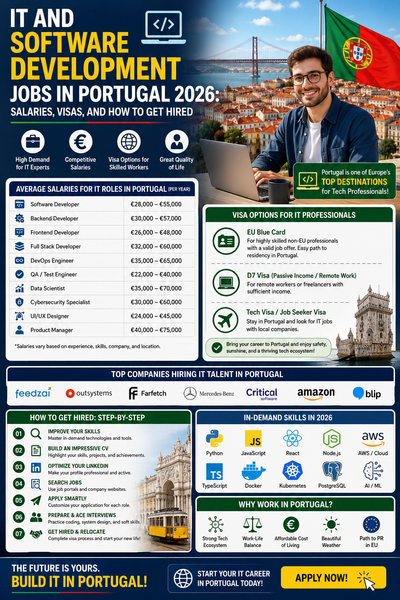
Top Companies Hiring Software and IT Talent in Portugal
- Google Lisbon — backend, cloud, and infrastructure engineering, with active work permit sponsorship
- Cloudflare — web infrastructure and security engineering roles based in Lisbon
- Farfetch — luxury e-commerce platform with major engineering hubs in both Lisbon and Porto, hiring across backend, frontend, and data engineering
- OutSystems — Porto-based low-code platform company and a anchor of the city’s startup scene
- Feedzai — fintech and fraud-prevention engineering, with hubs in both Lisbon and Porto
- Mercedes-Benz.io — automotive software engineering office in Lisbon
- Talkdesk and Unbabel — Portugal-founded global tech companies with substantial local engineering teams
Visa Routes for Foreign IT Professionals
Portugal offers several distinct visa pathways for tech workers, and picking the right one depends on your situation:
Tech Visa (Visto Tech)
The fastest route, designed for engineers joining IAPMEI-accredited tech companies (a list of certified employers is publicly available). Processing typically takes just 1–3 months, and companies like Google Lisbon, Cloudflare, and most major Portuguese startups qualify as accredited sponsors.
D3 Visa (Highly Qualified Activity Visa)
The standard route for non-EU skilled tech workers without an accredited-employer shortcut. It requires a binding job offer of at least 12 months in a qualifying role, a relevant degree or roughly five years of equivalent experience, and a salary of at least 1.5 times the national average — roughly €1,200–€1,600+ gross per month in 2026. Processing runs 30–60 days through a Portuguese consulate, and the resulting permit starts at two years with a three-year renewal.
D8 Digital Nomad Visa
Built for remote workers employed by non-Portuguese companies, requiring proof of stable income (around €3,480/month as a reference threshold). This is the common route for engineers who want to live in Portugal while keeping a job based abroad.
EU Blue Card
A good fit for higher-paid, highly qualified roles, with the added benefit of easier mobility to other EU countries later in your career.
Regardless of route, most applicants register with AIMA (the Agency for Integration, Migrations, and Asylum, which replaced the former SEF) after arrival to finalize their residence permit.
[Image placeholder 3 — alt text: “Passport and visa documents for relocating to Portugal as a tech worker”]
Tax Considerations: IFICI and the End of NHR
Portugal’s well-known NHR (Non-Habitual Resident) tax regime, which offered major tax breaks to new residents, ended for new applicants in 2024. It has been replaced by IFICI, a narrower regime offering a 20% flat tax rate for 10 years, but only for specific “highly qualified activities” that include research, innovation, and select tech roles. It’s worth confirming with a tax advisor whether your specific role and employer qualify before relying on this benefit in your relocation planning.
How to Apply for IT Jobs in Portugal
- Target accredited Tech Visa employers first if you’re outside the EU — sponsorship and processing are meaningfully faster through this route than a standalone D3 application.
- Use specialized tech job boards alongside general sites like LinkedIn, Indeed, and Glassdoor — dedicated platforms like ITJobs focus specifically on the Portuguese tech market.
- Apply directly to known sponsors. Farfetch, Google, Cloudflare, OutSystems, and Feedzai regularly hire and sponsor international engineers and post openings on their own career pages.
- Consider the Job Seeker Visa if you want to interview in person before committing — it allows a 120-day stay (extendable to 180) specifically to search for work on the ground in Portugal.
- If targeting remote roles, focus your search on companies outside Portugal that explicitly allow relocation to Portugal under a D8 or D7 visa, since most remote engineers based in the country work for U.S. or Northern European employers rather than local ones.
- Get your paperwork in order early: a relevant degree or documented experience, a clean criminal record, proof of financial self-sufficiency, and health insurance are standard requirements across nearly every visa route.
Porto vs. Lisbon for Tech Workers
- Lisbon — the larger market, home to most major international engineering offices and the highest salary ceiling, but also the highest cost of living
- Porto — 20–30% cheaper than Lisbon, with a fast-developing startup ecosystem anchored by companies like OutSystems, making it an increasingly attractive alternative for engineers who don’t need a Lisbon-specific employer
Skills Employers Look For
- Strong fundamentals in at least one major programming language relevant to the role (JavaScript, Python, Java, Go, etc.)
- Cloud platform experience (AWS, Azure, or GCP) for infrastructure-adjacent roles
- English fluency, since most international tech offices operate in English regardless of location
- A relevant degree or demonstrable equivalent professional experience, particularly for visa-sponsored roles
- For remote roles: proven ability to work independently across time zones
Frequently Asked Questions
Do I need to speak Portuguese to work in IT in Portugal? No. Most international tech offices in Lisbon and Porto operate in English, and Portuguese is rarely a strict requirement for engineering roles, though it can help with day-to-day life and smaller local employers.
What is the average software engineer salary in Portugal? National averages for mid-level engineers typically fall between €42,000 and €52,000 gross per year, while senior engineers at large international tech offices in Lisbon can earn €90,000–€140,000 or more in total compensation.
Which visa should I apply for as a foreign software engineer? The Tech Visa is the fastest option if you have an offer from an IAPMEI-accredited company. Otherwise, the D3 visa is the standard route for skilled workers, while the D8 visa suits remote employees working for non-Portuguese companies.
Can I work remotely from Portugal for a company based elsewhere? Yes. The D8 Digital Nomad Visa is designed specifically for this situation and requires proof of stable qualifying income from your foreign employer.
Is Portugal a good option if I want to earn a six-figure salary? Only at a limited number of international companies like Google, Cloudflare, or Farfetch. Most Portuguese employers pay considerably less than Western European tech hubs, so those specifically targeting €100K+ may find more direct paths in Germany, the Netherlands, or Ireland.
Final Thoughts
Portugal’s tech sector offers a genuinely attractive combination for foreign IT professionals: real hiring demand from both global and homegrown companies, multiple visa pathways built specifically for skilled tech workers, and a cost of living that stretches further than most Western European alternatives. Salaries at local companies remain modest by international standards, but international tech offices in Lisbon and the country’s fast-growing remote-work scene offer a realistic route to competitive pay without sacrificing the lifestyle that draws people to Portugal in the first place.