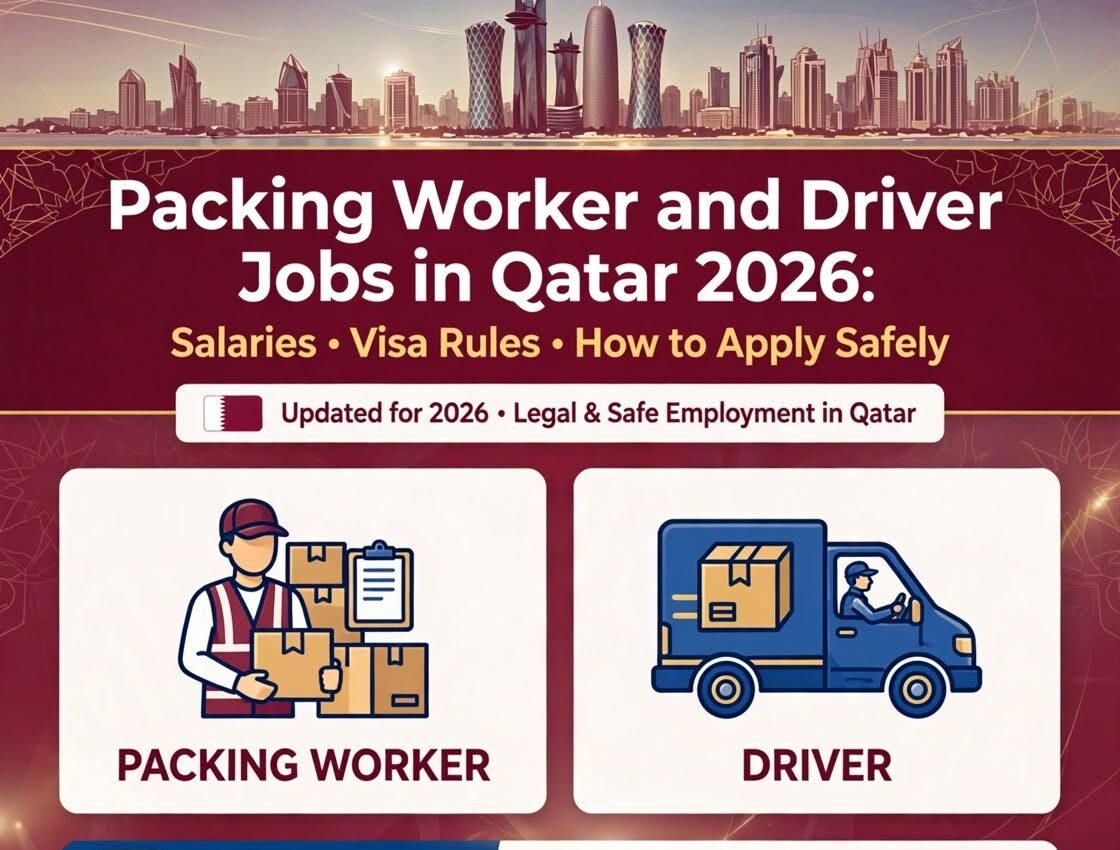
Qatar’s food processing, e-commerce, logistics, and construction sectors continue to hire large numbers of foreign packing workers and drivers every year. These roles are genuinely accessible — most require no prior experience or advanced qualifications — but the market is also crowded with informal recruitment practices that put workers at real financial risk. This guide covers what these jobs actually pay, what the legal visa process looks like, and how to protect yourself from the scams that are unfortunately common in this space.
[Image placeholder 1 — alt text: “Warehouse packing worker sorting boxes in a Qatar distribution center”]
Why Qatar Keeps Hiring Packing Workers and Drivers
Qatar’s economy continues to expand across food processing, e-commerce, pharmaceutical manufacturing, logistics, and retail supply chains, and all of these sectors depend heavily on foreign labor for packing, packaging, and driving roles. Qatar also operates a fully employer-sponsored visa system: your employer sponsors your entry visa and residence permit, known as the Qatar ID (QID), and reputable employers cover these costs directly rather than passing them on to workers.
Both packing and driving roles are typically classified as unskilled or semi-skilled work, meaning most positions require no prior experience, a basic educational certificate at most, and straightforward physical or driving competency rather than formal qualifications. This makes the sector genuinely accessible to a wide range of applicants — but it also makes it a frequent target for illegitimate recruiters exploiting workers who may not know their rights.
Types of Packing Worker Jobs in Qatar
1. General Packing Helper
Entry-level roles in food factories, warehouses, or retail distribution centers, involving sorting, boxing, and labeling products. No prior experience is typically required.
2. Food Factory Packing Worker
Packing roles specific to food processing plants, often paying somewhat more than general warehouse packing due to hygiene and food-safety training requirements.
3. Packaging Operator
A role involving operating packaging machinery rather than manual packing alone, generally requiring some technical familiarity or on-the-job training.
4. Warehouse Packer
Focused on preparing goods for shipment or storage within logistics and distribution warehouses, closely tied to Qatar’s growing e-commerce sector.
5. Packing Supervisor
A supervisory step up after gaining packing floor experience, overseeing a team and production targets.
Types of Driver Jobs in Qatar
1. Light Vehicle Driver
Requires a valid Qatar light vehicle driving license, commonly used for staff transport, deliveries, and general company driving duties.
2. Heavy Vehicle Driver
Requires a Qatar heavy vehicle license, covering trucks, buses, and larger commercial vehicles, typically paying more than light vehicle roles due to the additional licensing requirement.
3. Truck and Dump Truck Drivers
Common in Qatar’s active construction sector, often requiring both light and heavy license combinations plus prior experience with specific vehicle types.
4. Delivery Drivers
Tied closely to e-commerce and retail growth, delivering goods directly to customers or between company locations.
5. Personal/House Drivers
Roles working directly for private families or individuals, generally requiring a clean driving record and often including accommodation as part of the package.
[Image placeholder 2 — alt text: “Truck driver operating a heavy vehicle on a Qatar construction site”]
How Much Do Packing and Driver Jobs Pay in Qatar?
Salaries vary considerably by role, employer, and whether accommodation and food are included. Here’s a realistic breakdown based on current job market listings:
| Role | Typical Monthly Salary (QAR) |
|---|---|
| Entry-level packing helper (food factory/warehouse) | 800 – 1,400 |
| Factory worker (general, per QIMC-style postings) | 1,800 – 3,200 |
| Light vehicle driver | 2,000 – 5,000 |
| Heavy vehicle driver | 1,800 – 4,000+ (varies with FAT — food, accommodation, transport — allowances) |
| House/personal driver | 1,500 – 2,500 (often with free food and accommodation) |
| General labor jobs (construction/warehouse) | 1,200 – 3,500 |
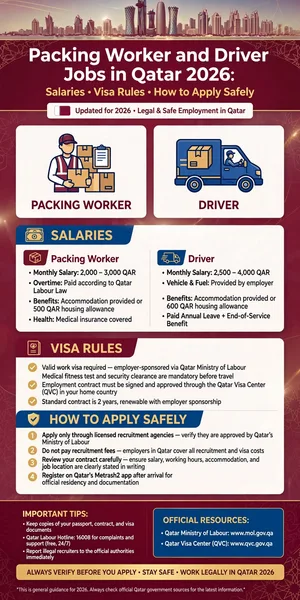
Important context on these numbers: Qatar’s government has set a non-discriminatory minimum wage that applies to all workers regardless of nationality or sector. As of the most recent labor law updates, the baseline compensation package for workers not provided food or housing by their employer must total at least QAR 1,800 per month — made up of a QAR 1,000 basic wage, a QAR 500 housing allowance, and QAR 300 for food. Any job offer paying less than this combined total for a worker without provided housing and food may not comply with Qatari labor law, and it’s worth verifying pay structures carefully before accepting an offer.
How the Qatar Work Visa System Works
Qatar operates on an employer-sponsored visa system, historically known as “kafala,” though the system has undergone real reforms in recent years. Here’s what applies in 2026:
- Your employer sponsors your entry visa and Qatar ID (QID) — a legitimate employer covers these costs directly
- Reforms have removed the requirement to get employer permission to change jobs in most cases, and workers can now generally process job transfers independently through the Ministry of Labour’s electronic system without needing a No Objection Certificate (NOC) from their previous employer
- A minimum wage now applies to all workers, regardless of nationality, sector, or whether they’re covered by standard labor law protections
- The Wage Protection System (WPS) requires salaries to be paid directly into your bank account on a set schedule, giving workers a documented, legally enforceable payment record
Important caveat: despite these reforms, independent human rights monitoring organizations have continued to document real gaps in enforcement, including cases of passport confiscation, illegal recruitment fees, and practical difficulty changing jobs even where the law technically allows it. Reforms represent genuine legal progress, but workers should still go in informed and cautious rather than assuming full protection in practice.
[Image placeholder 3 — alt text: “Foreign worker reviewing an employment contract and visa documents for Qatar”]
How to Avoid Recruitment Scams
This is one of the most important sections in this guide, because the packing and driving job market in Qatar attracts a significant volume of informal, unverified recruitment activity — much of it through WhatsApp groups, classified listings, and social media posts rather than proper job platforms. Watch for these red flags:
- Any request for you to pay visa fees, processing fees, or “guaranteed job” fees upfront. This is illegal under Qatari labor law. Legitimate employers cover visa and recruitment costs — if a recruiter asks you to pay first, treat it as a serious warning sign.
- Listings that pressure “WhatsApp me, don’t call” or discourage normal verification. Legitimate employers and licensed agencies are generally reachable through standard channels and don’t discourage scrutiny.
- Vague job descriptions with no company name, verifiable address, or licensing information.
- Promises of unusually high pay for unskilled roles that don’t match the going market rate for similar positions.
- Requests to hand over your passport before your contract and visa are fully processed and confirmed.
How to verify a legitimate employer or recruiter:
- Check the employer or recruitment agency against Qatar’s official Ministry of Labour portal, which lists licensed operators
- Confirm the job offer includes a written contract using Ministry-approved templates before you travel or pay anything
- Ask specifically whether your salary will be paid through the Wage Protection System (WPS) — a legitimate employer should have no hesitation confirming this
- Be aware that under recent labor law amendments, recruitment agencies face real administrative penalties (ranging from QAR 3,000 to QAR 25,000) for violations like using non-approved contracts or skipping required medical exams — a licensed, compliant agency will be able to speak to these requirements confidently
How to Apply for Packing and Driver Jobs in Qatar
- Prepare standard documentation first: a valid passport with at least six months’ validity, a simple CV listing any relevant experience, passport-sized photos, and educational certificates (a basic school certificate is sufficient for most packing roles).
- For driver roles, confirm license requirements precisely. Qatar distinguishes clearly between light and heavy vehicle licenses, and many postings require a Qatar-issued license specifically rather than one from your home country, so clarify this before applying.
- Use verified job platforms and company career pages alongside general listings, cross-checking any recruiter against the Ministry of Labour’s licensed agency list.
- Confirm the full compensation package in writing, including whether food, accommodation, and transport are provided, since these significantly affect your real take-home value beyond the base salary figure.
- Never pay any fee to secure a job offer or visa. If an employer or agency insists on this, walk away and report the listing if possible.
- Get everything in writing before travel, including your contract, visa sponsorship confirmation, and agreed salary and benefits.
Working Conditions and Basic Rights to Know
- Standard working hours are capped at 8 hours per day and 48 hours per week, reduced to 6 hours per day and 36 hours per week during Ramadan
- Overtime pay is legally required and should be compensated according to Qatari labor law
- Paid annual leave starts at three weeks per year for the first five years of service, increasing to four weeks after five years
- Paid sick leave of up to two weeks is available with a valid medical certificate
- End-of-service gratuity is owed to employees who complete at least one year of continuous service, calculated at a minimum of 21 days of final basic wage per year worked
Knowing these baseline entitlements matters — they give you a concrete standard to check your own contract and treatment against once you’re working in Qatar.
Frequently Asked Questions
Do I need experience to get a packing job in Qatar? No. Most entry-level packing helper roles require no prior experience, and employers typically provide on-the-job training.
What license do I need to drive in Qatar? It depends on the vehicle type — light vehicle roles require a Qatar light vehicle license, while heavy vehicle and truck roles require a Qatar heavy vehicle license. Some postings accept a valid GCC license as a starting point, but many require you to hold or convert to a Qatar-issued license.
Is it legal for a recruiter to ask me to pay for my visa? No. Charging workers for visa or recruitment fees is illegal under Qatari labor law. Legitimate employers cover these costs directly, and any request for upfront payment is a serious red flag.
What is the minimum wage in Qatar? Qatar’s minimum wage sets a baseline of QAR 1,000 in basic wage, with a combined compensation package of at least QAR 1,800 per month for workers not provided food or accommodation by their employer.
How can I check if a Qatar employer or recruitment agency is legitimate? You can verify licensed employers and recruitment agencies through Qatar’s official Ministry of Labour portal, and you should always confirm your contract uses Ministry-approved templates before accepting an offer.
Final Thoughts
Packing and driving jobs remain some of the most accessible entry points into Qatar’s labor market for foreign workers, with genuine, high-volume demand across food processing, logistics, and construction. The pay is modest but often comes with food, accommodation, and transport included, and real legal protections — a minimum wage, the Wage Protection System, and simplified job-change processes — now exist on paper. The single most important thing you can do before accepting any offer is verify the employer independently, confirm your contract in writing, and refuse any request to pay fees upfront. Reforms have made Qatar’s labor system meaningfully better than it once was, but the burden of caution still falls heavily on the worker, so approach every offer with careful verification rather than urgency.