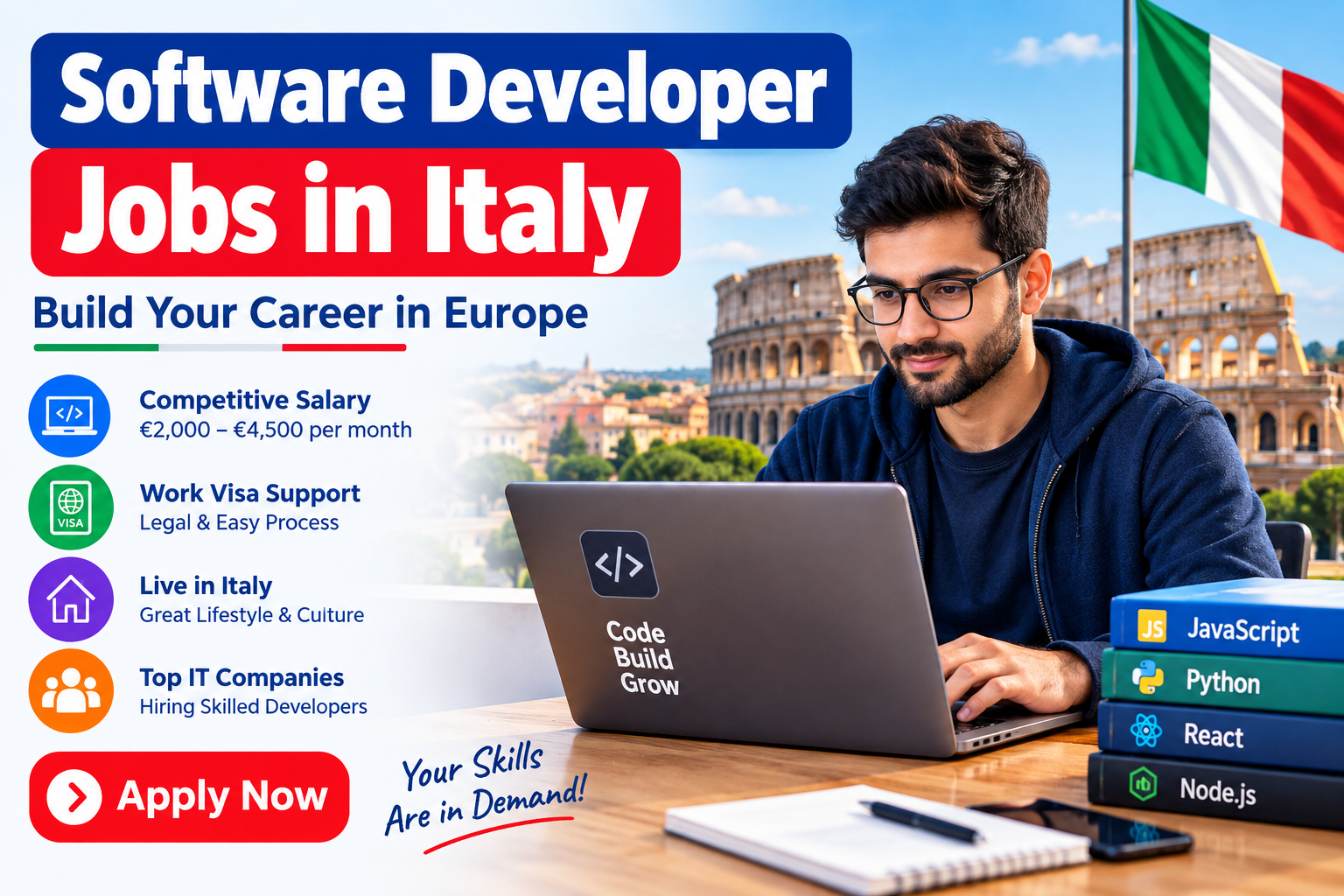
Ask most developers where they would like to work in Europe and you will hear Berlin, Amsterdam, or Dublin. Italy rarely makes the shortlist. That is a missed opportunity. Italy has the fourth-largest economy in the European Union, a deep industrial base, a growing startup scene, and a long-running shortage of digital talent. Banks, manufacturers, fashion houses, energy companies, and public institutions are all modernizing, and every one of them needs people who can write, test, and ship software.
This guide covers software developer jobs in Italy from every angle: which skills employers want, what you can expect to earn, which cities hire the most, how visas work for non-EU candidates, and how to run a job search that gets replies. Whether you are already in Europe or planning a move from abroad, you will find practical steps here.
Why Italy Is Becoming a Serious Tech Destination
A Digital Transformation Still in Progress
Italy has traditionally lagged behind northern Europe on digitalization, and that gap is exactly what creates demand. Companies are migrating legacy systems to the cloud, public administration is moving services online, and small manufacturers are adopting automation under the “Industry 4.0” banner. Each of these projects needs developers, DevOps engineers, and data specialists.
Read Also: Accountant and Business Development Consultant Jobs in Italy
Strong Traditional Industries Need Software
Italy’s economy is built on sectors where software is now a competitive advantage:
- Manufacturing and automation: machinery, automotive, and robotics firms embed software in nearly every product.
- Fashion and luxury: e-commerce platforms, supply chain tools, and personalization engines.
- Banking and insurance: core system modernization, fintech, and cybersecurity.
- Energy and utilities: smart grids, renewable energy monitoring, and IoT.
- Tourism and hospitality: booking engines, dynamic pricing, and mobile apps.
Quality of Life Beats Most Tech Hubs
Salaries in Italy are lower than in Germany or the Netherlands, but so is the cost of living outside the biggest cities. Add excellent food, a generous holiday allowance, public healthcare, and a culture that values life outside the office, and many developers find the overall package appealing.
In-Demand Skills for Software Developers in Italy
Italian employers hire across the whole stack. The following skills appear most often in job listings.
Programming Languages
- Java and Kotlin: dominant in banking, insurance, and enterprise systems.
- JavaScript and TypeScript: essential for web development, with React, Angular, and Vue.js all in demand.
- Python: widely used for backend work, automation, and data and AI roles.
- C# and .NET: common in mid-sized companies and consultancies.
- PHP: still present in e-commerce and agency work, especially with Laravel and Symfony.
- C and C++: valued in embedded systems, automotive, and industrial software.
Cloud, DevOps, and Infrastructure
Experience with AWS, Microsoft Azure, or Google Cloud, plus Docker, Kubernetes, CI/CD pipelines, and Terraform, makes you noticeably more competitive. DevOps and platform engineers are among the harder roles for Italian companies to fill.
Emerging Specializations
- Artificial intelligence and machine learning
- Cybersecurity and secure coding
- Data engineering (Spark, Airflow, SQL, data warehousing)
- Mobile development (Swift, Kotlin, Flutter, React Native)
- SAP and ERP development, which is surprisingly strong in Italy’s industrial sector
Soft Skills and Language
English is the working language in many international teams and startups, but basic Italian opens far more doors, particularly in traditional companies, consultancies, and public-sector contractors. Even A2 or B1 level shows commitment and helps with daily life.
Software Developer Salary in Italy
Compensation is the area where expectations need the most calibration. The figures below are typical gross annual ranges based on market patterns. Actual offers vary by city, company size, and sector, so treat them as starting points rather than guarantees.
| Level | Typical Gross Annual Salary |
|---|---|
| Junior (0–2 years) | €24,000 – €32,000 |
| Mid-level (3–5 years) | €32,000 – €45,000 |
| Senior (5+ years) | €45,000 – €65,000 |
| Lead / Architect / Engineering Manager | €60,000 – €90,000+ |
What Pushes Pay Higher
- Location: Milan generally pays the most, followed by Rome and Turin.
- Employer type: multinationals, scale-ups, and foreign companies with Italian offices tend to pay above local averages.
- Specialization: cloud, AI, security, and SAP skills command premiums.
- Remote work for foreign employers: some developers based in Italy earn northern European salaries while enjoying Italian living costs.
Understand Your Contract
Italian employment contracts usually include a 13th month salary (tredicesima), and sometimes a 14th, so check whether an advertised figure is spread over 12, 13, or 14 payments. Also compare gross (RAL) against net pay, since income tax and social contributions are significant. Employers also commonly offer meal vouchers, health insurance, and training budgets.
Best Cities for Developer Jobs in Italy
Milan: The Tech and Finance Capital
Milan is the country’s largest tech market. Fintech, e-commerce, consulting, fashion tech, and multinational offices cluster here. It has the highest salaries and the most English-speaking roles, but also the highest rent.
Rome: Government, Telecom, and Enterprise
Rome offers opportunities in public-sector projects, telecommunications, defense, and large corporations. The startup scene is growing, and the pace of life is often calmer than in Milan.
Turin: Automotive and Industrial Software
Turin, historically the home of Italian car manufacturing, has a strong engineering culture. Automotive software, embedded systems, and industrial IoT are the specialties, with a lower cost of living than Milan.
Bologna and Emilia-Romagna: Research and Manufacturing
Bologna combines a world-famous university, a vibrant research ecosystem, and neighboring “Motor Valley” companies. It is attractive for AI, robotics, and high-performance computing roles.
Other Cities Worth Watching
- Trento and Bolzano: research institutes, excellent quality of life, and strong salaries relative to cost of living.
- Padua and Venice area: manufacturing and logistics software.
- Naples and Catania: growing tech communities and development centers of international companies, with lower living costs.
Visa and Work Permit Options for Non-EU Developers
EU and EEA citizens can live and work in Italy without a visa. Everyone else needs a permit linked to employment. The rules change, so always confirm current details with the Italian authorities before applying.
EU Blue Card
The EU Blue Card is the most relevant route for qualified developers. It is for highly qualified non-EU professionals who hold a job offer from an Italian employer. Recent reforms lowered the salary requirement; the gross annual salary must be at least the average gross annual salary in Italy as defined by ISTAT. Some secondary sources still quote a higher multiple of the average, so verify the live figure with the Italian authorities before filing. Another notable change is that reforms recognize professional experience in place of formal education for certain sectors, particularly IT, which is good news for self-taught developers and bootcamp graduates. italyhandbookitalyhandbook
Standard Work Visa Under the Decreto Flussi
Italy issues a limited number of work permits each year through the Decreto Flussi quota system. These are tied to specific employers and sectors and are processed in set application windows. They can work for developers, but the quota nature makes them less predictable than the Blue Card.
Intra-Company Transfer
If you already work for a multinational with an Italian branch, an intra-company transfer can be a fast route.
Digital Nomad and Remote Work Visas
Italy has introduced a visa aimed at remote workers who earn income from clients or employers abroad. It is aimed at those who are not employed by an Italian company, and it comes with income, insurance, and accommodation requirements. Check the latest rules before planning around it.
Study-to-Work Route
Many international students complete a master’s degree at an Italian university, then convert their student permit into a work permit. Italian public universities have low tuition compared with other European countries, which makes this a cost-effective way to enter the market.
How to Find Software Developer Jobs in Italy
Step 1: Prepare an Italian-Ready CV
- Keep it to one or two pages, in reverse chronological order.
- Include a short professional summary, a clear skills section, and links to GitHub or a portfolio.
- Use the Europass format if applying to public institutions or traditional employers; otherwise a clean modern layout works fine.
- Mention your language levels honestly.
- In Italy, a consent line for data processing (GDPR) is commonly added at the bottom.
Step 2: Use the Right Platforms
- LinkedIn: the primary channel for international and tech roles.
- Indeed Italia and InfoJobs: broad coverage of local employers.
- Glassdoor: useful for salary and company research.
- Company career pages: many Italian firms post directly, especially larger ones.
- Startup and remote job boards: useful for English-first teams.
- Recruitment agencies and IT consultancies: very common in Italy, and often a quick way to your first role.
Step 3: Network, Online and Offline
Italian hiring relies heavily on referrals and personal connections. Attend tech meetups in Milan, Rome, and Turin, join developer communities on Slack and Discord, and engage with local engineers on LinkedIn. Hackathons and conferences are also good places to be noticed.
Step 4: Prepare for the Interview Process
Typical hiring involves:
- A screening call with HR or a recruiter.
- A technical interview, with coding exercises, system design, or a take-home assignment.
- A conversation with the team lead or hiring manager.
- An offer discussion, which often includes contract type and benefits.
Be ready to discuss notice periods, which can be long in Italy, and your salary expectations in gross annual terms.
Step 5: Understand the Contract Types
- Tempo indeterminato (permanent): the standard and most secure contract.
- Tempo determinato (fixed-term): common for projects.
- Partita IVA (freelance): popular among consultants, with different tax and benefit implications.
For visa purposes, a salaried employment contract is typically required.
Working Culture for Developers in Italy
Hours and Holidays
The standard week is 40 hours. Italian employees usually receive at least four weeks of paid holiday, plus around a dozen public holidays, and August is famously quiet.
Team Style
Italian workplaces often value relationships and face-to-face communication. Startups and international companies tend to be flatter and more agile, while traditional firms may be more hierarchical. Hybrid work has become common, and fully remote roles exist, though less widely than in northern Europe.
Career Growth
Growth can be slower than in some markets, so ambitious developers often move between companies to advance. Strong technical skills combined with English fluency make it easier to move into international or senior positions.
Advantages and Challenges
Advantages
- Rising demand for IT talent.
- Lower cost of living than many European tech hubs, especially outside Milan.
- Excellent healthcare, food, and lifestyle.
- A path to long-term residence, and eventually citizenship, for those who stay.
- Opportunities to work on meaningful projects in industries with global brands.
Challenges
- Salaries lower than in Germany, Switzerland, or the Netherlands.
- Bureaucracy that can feel slow, from permits to bank accounts.
- Italian language needs outside international companies.
- Fewer remote and ultra-high-paying roles than in some other countries.
Tips to Stand Out as a Foreign Developer
- Learn Italian early. Even basic conversation changes how employers see you.
- Show a portfolio. Public repositories, side projects, and open-source contributions carry weight, especially if you lack a formal degree.
- Target shortage skills. Cloud, DevOps, security, and AI reduce competition.
- Apply to international companies first. They are more used to sponsoring visas.
- Be flexible on location. A role in a mid-sized city may offer the better overall package.
- Get your documents ready. Degree recognition and apostilled papers can take time, so start early.
Conclusion
Italy may not have the loudest tech reputation in Europe, but that is part of its appeal. Software developer jobs in Italy combine growing demand, accessible visa routes for qualified professionals, and a quality of life that is hard to match. You will probably not top the European salary charts, but you can build a rewarding career, learn a new language, and live in one of the most beautiful countries in the world.
If you are ready to start, update your CV, pick two or three target cities, and begin networking this week. The developers who move early, before the market fully catches up with its need for talent, tend to benefit most.
Frequently Asked Questions (FAQ)
Can foreign software developers find jobs in Italy without speaking Italian?
Yes, especially in Milan, in startups, and at multinational companies where English is the working language. However, Italian greatly widens your options and makes daily life easier.
What is the average software developer salary in Italy?
Typical gross salaries run from roughly €24,000–€32,000 for juniors to €45,000–€65,000 or more for seniors, with Milan and international employers paying at the higher end.
Which visa is best for a software developer moving to Italy?
For most qualified non-EU developers with a job offer, the EU Blue Card is the most attractive option. Other routes include Decreto Flussi work permits, intra-company transfers, and the study-to-work pathway.
Do I need a university degree to work as a developer in Italy?
Not always. For Blue Card purposes, recent reforms allow professional experience in IT to substitute for formal education in some cases. Employers also value portfolios and proven skills. Check the exact criteria for your situation.
Which Italian city is best for tech jobs?
Milan has the largest and best-paid market, Rome offers enterprise and public-sector roles, Turin specializes in automotive and industrial software, and Bologna is strong in research and AI.
Is remote work common in Italy?
Hybrid arrangements are common, and fully remote roles exist, particularly with startups and foreign companies. Fully remote positions are less widespread than in some northern European countries.
How long does it take to find a developer job in Italy?
It commonly takes two to six months, depending on your experience, skills, language level, and whether you need visa sponsorship.
Immigration rules, salary thresholds, and market conditions change, so verify current requirements with official Italian government sources before making decisions.