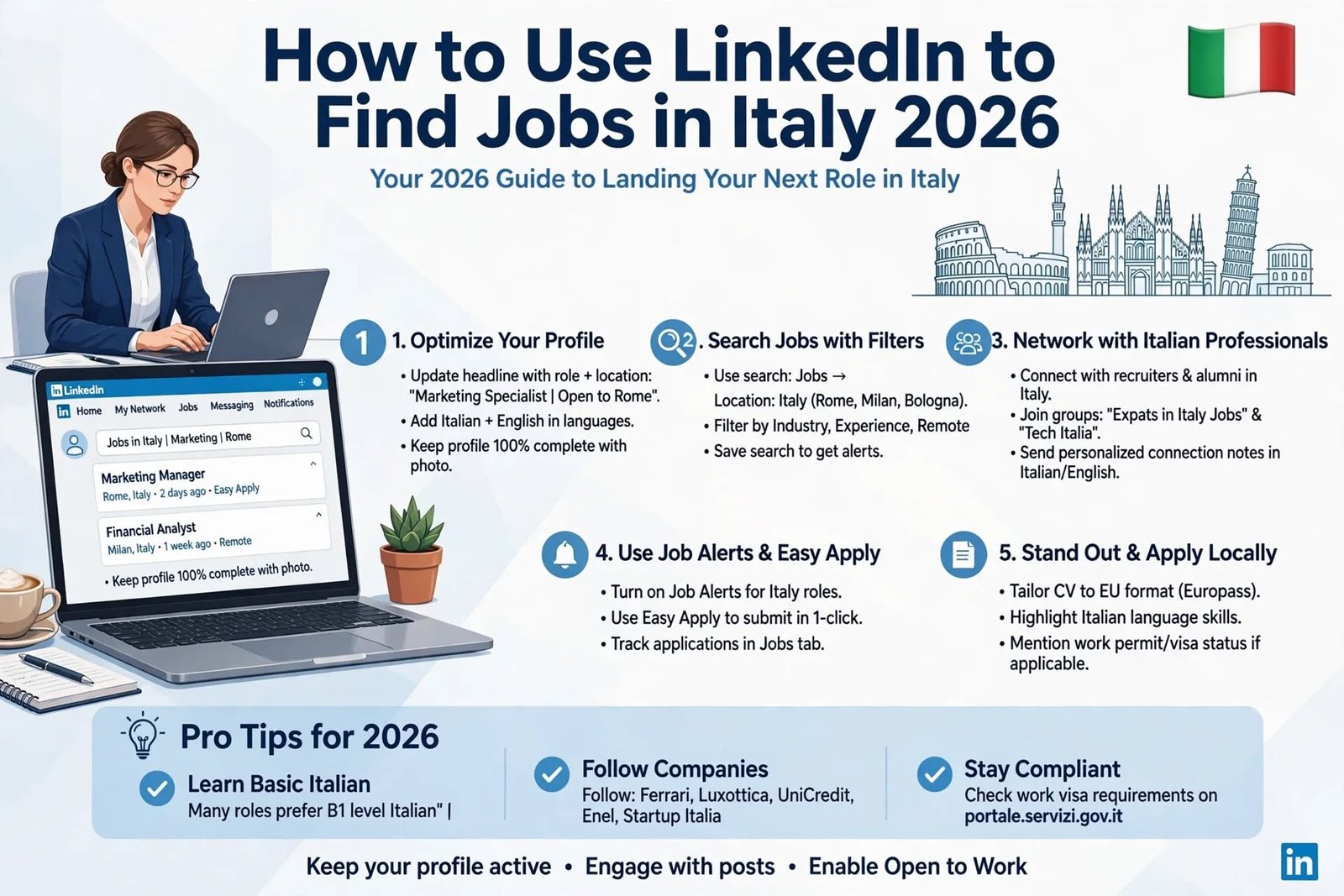
Italy attracts job seekers for good reasons. It has the eurozone’s third-largest economy, world-famous industries like fashion, food, automotive, engineering, and tourism, and a lifestyle that few countries can match. Whether you dream of working in a Milan tech startup, a Turin automotive plant, or a hotel on the Amalfi Coast, the first question is the same: where do you actually find the jobs?
One of the best answers is LinkedIn. Italian companies, multinational firms, recruitment agencies, and HR professionals all use the platform to post vacancies and search for candidates. If you know how to use LinkedIn to find jobs in Italy, you can reach employers directly, build useful connections, and apply from anywhere in the world.
But simply creating an account is not enough. Thousands of applicants compete for every attractive role, and the ones who succeed are those who set up their profile properly, search with intention, and approach recruiters professionally.
This guide walks you through the whole process, from profile setup to interview invitations, in plain language.
Read Also: Seasonal Farm Worker Jobs in Italy
Why LinkedIn Is Useful for Finding Jobs in Italy
Italy’s Growing Digital Hiring Culture
Traditionally, Italian hiring leaned on personal contacts and local newspapers. That has changed. Large companies, international employers, and recruitment firms now post openings on LinkedIn routinely, especially in technology, engineering, finance, marketing, healthcare administration, logistics, and hospitality management.
Benefits for International Job Seekers
- Direct access to recruiters: You can see who is hiring and contact them.
- Company research: You can learn about employers before you apply.
- Global visibility: Recruiters in Italy can find your profile even if you live abroad.
- Free to start: The core features you need cost nothing.
- Networking: Connections with people already working in Italy give you insider knowledge.
Where LinkedIn Works Best (and Where It Doesn’t)
LinkedIn is strongest for white-collar and skilled professional roles: IT, engineering, marketing, sales, finance, project management, and corporate positions. For seasonal, hospitality, farm, or factory work, you will often also need local job boards and agencies. We cover those later.
Step 1: Build a Strong LinkedIn Profile for the Italian Market
Your profile is your digital CV. Recruiters usually decide within seconds whether to keep reading.
H3: Choose a Professional Photo and Banner
Use a clear, friendly headshot with good lighting and a plain background. Dress as you would for an interview in your industry. Add a simple banner image related to your field.
H3: Write a Keyword-Rich Headline
Your headline is more than your job title. It is one of the most searchable parts of your profile. Compare these two:
- Weak: “Looking for opportunities”
- Strong: “Mechanical Engineer | CAD & Automotive Design | Open to Relocate to Italy”
Include your role, key skills, and your interest in Italy.
H3: Craft a Compelling “About” Section
Write 3 to 5 short paragraphs covering:
- Who you are professionally
- Your key strengths and achievements (use numbers where possible)
- Why you want to work in Italy
- What kind of role you are seeking
Mention your language skills honestly. If you speak some Italian, say so, even at a basic level. It shows commitment.
H3: Detail Your Experience With Results
Do not just list duties. Show impact:
- “Managed a team of 8 technicians and reduced downtime by 15%”
- “Handled 200+ customer accounts across three European markets”
H3: Add Skills and Get Endorsements
List at least 10 to 15 relevant skills. Pin your top three. Ask colleagues to endorse them, since profiles with endorsed skills look more credible.
H3: Add Languages and Certifications
English is valuable in Italy’s international companies, but Italian is a major advantage. Add every language with a proficiency level. Include certifications such as CELI, CILS, IELTS, or professional qualifications.
H3: Consider a Bilingual or Italian-Friendly Profile
LinkedIn lets you create a profile in multiple languages. If you can, add an Italian version. It helps with search visibility and makes Italian recruiters more comfortable.
Step 2: Set Your Location and Job Preferences Correctly
LinkedIn’s search works heavily on location and settings.
H3: Location Settings
If you live outside Italy, think carefully. Many recruiters filter candidates by location. Some options:
- Set your location to your current country but state clearly in your headline and About section that you are relocating to Italy.
- If you are already in Italy (for example, on a study or other valid permit), list your Italian city.
Be honest. Misrepresenting your location can cause problems later in the hiring process.
H3: Turn On “Open to Work”
In your profile settings, activate Open to Work and add:
- Job titles you want
- Locations (Milan, Rome, Turin, Bologna, or “Italy” broadly)
- Job types (full-time, contract, remote)
- Start date
You can choose to share this with recruiters only, which keeps it private from your current employer’s network, or display the green banner publicly.
H3: Set Up Job Alerts
Save your searches and turn on alerts. LinkedIn will send you new matching jobs daily or weekly, so you can apply early. Early applicants often get more attention.
Step 3: Search for Jobs in Italy the Smart Way
H3: Use the Right Keywords
Search in both English and Italian. For example:
| English | Italian |
|---|---|
| Software Developer | Sviluppatore Software |
| Nurse | Infermiere/a |
| Accountant | Contabile |
| Chef | Cuoco / Chef |
| Sales Manager | Responsabile Vendite |
| Logistics Coordinator | Addetto Logistica |
Italian keywords reveal roles that English searches miss, especially in smaller companies.
H3: Apply Filters
Narrow your results using:
- Location: Italy, or specific cities like Milano, Roma, Torino, Bologna, Firenze
- Date Posted: Past 24 hours or past week
- Experience Level: Entry, associate, mid-senior
- Job Type: Full-time, part-time, contract, internship
- Remote: On-site, hybrid, or remote
- Easy Apply: Quick applications within LinkedIn
H3: Know Italy’s Major Job Hubs
- Milan: Finance, fashion, design, tech, consulting, advertising
- Rome: Government-related roles, international organizations, tourism, media
- Turin: Automotive, engineering, aerospace
- Bologna: Manufacturing, food industry, mechatronics, education
- Veneto and Emilia-Romagna regions: Manufacturing and export industries
- Florence: Luxury goods, tourism, crafts
H3: Look for Visa Sponsorship Signals
Search phrases like “visa sponsorship,” “relocation support,” or “international candidates welcome.” Many listings will not mention visas at all, so you may need to ask recruiters directly (more on that below).
Step 4: Follow Companies and Research Employers
H3: Follow Target Companies
Make a list of 20 to 30 companies in Italy that match your skills. These could include:
- Large Italian employers in your sector
- Multinationals with Italian offices
- Fast-growing startups
- Recruitment agencies such as Randstad, Adecco, ManpowerGroup, Hays, Michael Page, and others operating in Italy
Following them puts their updates and job posts in your feed.
H3: Study Company Pages
Check the “People” tab to see who works there, where they studied, and whether other foreigners are employed. That tells you how open the company is to international hires.
H3: Read the Posts
Companies often post hiring announcements, culture updates, and event news. Commenting thoughtfully on these posts can make your name familiar to their recruiters.
Step 5: Network With Recruiters and Professionals in Italy
Networking is the most underrated way to find jobs in Italy. Many positions are filled through referrals before they are ever advertised.
H3: Find the Right People
Use the search bar to look for:
- “Talent Acquisition Italy”
- “Recruiter Milano”
- “HR Manager Roma”
- Professionals with your target job title working in Italy
H3: Send Personalized Connection Requests
Generic requests are often ignored. Keep it short, polite, and specific:
“Hello Marco, I am a mechanical engineer with five years of experience in automotive design. I’m exploring opportunities in Turin and admire your company’s work. I’d be glad to connect.”
H3: Follow Up With a Respectful Message
Once connected, wait a day or two, then send a brief message:
- Thank them for connecting
- Introduce yourself in one sentence
- Mention a specific role or ask for advice
- Attach nothing, and keep it under 100 words
H3: Ask for Information, Not Just a Job
People respond better to questions like “What skills are most valued in your team?” than to “Please give me a job.” This builds relationships that can lead to referrals later.
H3: Join LinkedIn Groups
Look for groups such as expat communities in Italy, industry groups, and alumni networks. Participate regularly by sharing useful insights rather than only promoting yourself.
Step 6: Apply Effectively
H3: Easy Apply vs. Company Website
Easy Apply is fast but also very competitive, because everyone can use it. When possible, apply through the company’s own career page too, or message the recruiter after applying.
H3: Prepare an Italian-Friendly CV
- Keep it to 1 or 2 pages
- Use a clean format (many employers also accept Europass CV)
- Include a professional photo only if the employer expects it (practice varies, so follow the job posting)
- Add your nationality, languages, and work authorization status if relevant
- Tailor it to each job, mirroring keywords from the posting
H3: Write a Short Cover Letter
Explain in 150 to 250 words why you fit the role and why you want to work in Italy. Mention relocation plans and availability honestly.
H3: Track Your Applications
Use a simple spreadsheet with company name, role, date applied, recruiter contact, and follow-up date. Following up after 7 to 10 days is acceptable and often helpful.
Step 7: Use LinkedIn Content and Visibility to Your Advantage
H3: Post and Comment Regularly
You do not need to be an influencer. Post once or twice a week about:
- What you learned in your industry
- Your projects or achievements
- Your journey toward working in Italy
Comment meaningfully on posts by Italian professionals. Visibility attracts recruiters.
H3: Use Relevant Hashtags
Examples: #JobsInItaly, #LavoroInItalia, #HiringInItaly, #MilanJobs, plus hashtags for your field.
H3: Ask for Recommendations
Two or three written recommendations from past managers or clients add real credibility.
Should You Pay for LinkedIn Premium?
LinkedIn Premium is optional. Some benefits include:
- See who viewed your profile
- Send a limited number of InMail messages to people you are not connected with
- Access insights on applicants for a job
- Online learning courses
Consider using the free trial during an intensive search period. Many job seekers succeed without paying, so do not feel pressured.
Understanding Work Permits and Visas
LinkedIn can help you find an employer, but legal work authorization is a separate step. Key points:
- EU/EEA citizens can generally work in Italy without a work visa.
- Non-EU citizens usually need a work permit and visa. Employment in Italy for non-EU workers is commonly tied to annual quotas, often called Decreto Flussi, and an employer’s request.
- The EU Blue Card is available for highly qualified professionals who meet the salary and qualification criteria.
- Some categories, such as seasonal work, specific skilled roles, or students who complete degrees in Italy, follow different rules.
Rules and quotas change from year to year, so always check official sources such as the Italian Ministry of Foreign Affairs, the Ministry of Interior, or the Italian embassy or consulate in your country before making decisions. This article is general information, not legal advice.
Common Mistakes to Avoid
- Using an incomplete profile. Profiles with a photo, headline, and detailed experience attract far more views.
- Mass-applying without tailoring. A generic CV rarely stands out.
- Ignoring Italian. Even basic Italian can set you apart.
- Only applying online. Networking often opens doors that applications do not.
- Spamming recruiters. Be respectful and concise.
- Falling for scams. See the next section.
- Giving up too early. International job searches often take several months.
How to Spot Fake Job Offers on LinkedIn
Unfortunately, scammers target people dreaming of working abroad. Watch for these red flags:
- The recruiter asks you to pay a fee for a visa, a job guarantee, or “processing”
- The company has no real website, no employees on LinkedIn, or a profile created recently
- The offer seems too good to be true: very high pay for little experience
- You are asked to move the conversation to a private messaging app immediately and send passport copies or bank details before any interview
- Messages contain frequent spelling errors or free email addresses (Gmail, Yahoo) instead of company email domains
A genuine employer does not charge you to hire you. Always verify the company independently, and check the official website for the same job listing.
Alternatives to Use Alongside LinkedIn
Do not rely on one platform alone. Combine LinkedIn with:
- Indeed Italia and InfoJobs
- Glassdoor for company reviews
- EURES (the European job mobility portal)
- Company career pages
- Recruitment agencies in Italy
- Sector-specific sites for hospitality, tech, or healthcare
A Sample 30-Day LinkedIn Action Plan
Week 1: Foundation
- Complete your profile, headline, About section, and skills
- Turn on Open to Work and set job alerts
Week 2: Research
- Follow 25 target companies
- Identify 30 recruiters and professionals to connect with
Week 3: Outreach
- Send 5 to 10 personalized connection requests daily
- Apply to 10 to 15 well-matched jobs
Week 4: Follow-up and Visibility
- Message new connections
- Post one or two updates
- Follow up on applications and review what is working
Repeat and refine each month.
Conclusion
Learning how to use LinkedIn to find jobs in Italy is about more than clicking “Apply.” It means presenting yourself as a credible professional, searching in the right way, building genuine relationships, and staying alert to scams. Start with a strong profile, use Italian and English keywords, follow target companies, network respectfully, and be patient. Italy’s job market rewards persistence and preparation.
Take the first step today: update your headline, turn on job alerts, and send your first five connection requests. Each small action brings you closer to a job in Italy.
Frequently Asked Questions (FAQ)
1. Can I find a job in Italy using LinkedIn from another country?
Yes. Many recruiters and companies accept applications from abroad, especially for professional and skilled roles. Be clear about your relocation plans and work authorization status.
2. Do I need to speak Italian to get a job through LinkedIn?
Not always. International companies and tech firms often work in English. However, Italian improves your chances significantly, and for many roles it is required.
3. Is LinkedIn free to use for job hunting in Italy?
Yes, the basic features, including searching, applying, and networking, are free. Premium is optional.
4. Can LinkedIn help me get a visa for Italy?
LinkedIn can connect you with employers, but the visa process is separate and handled through official channels. Employers usually must support the work permit process for non-EU workers.
5. How long does it take to find a job in Italy on LinkedIn?
It varies by field and experience. Many people need two to six months or longer. Consistent effort and a strong profile shorten the process.
6. Is it safe to share my CV with recruiters on LinkedIn?
Generally yes, if you verify the recruiter and company. Never pay money or share sensitive documents like passport scans before a legitimate offer and proper verification.
7. Which Italian cities have the most jobs on LinkedIn?
Milan has the largest concentration, followed by Rome, Turin, and Bologna.