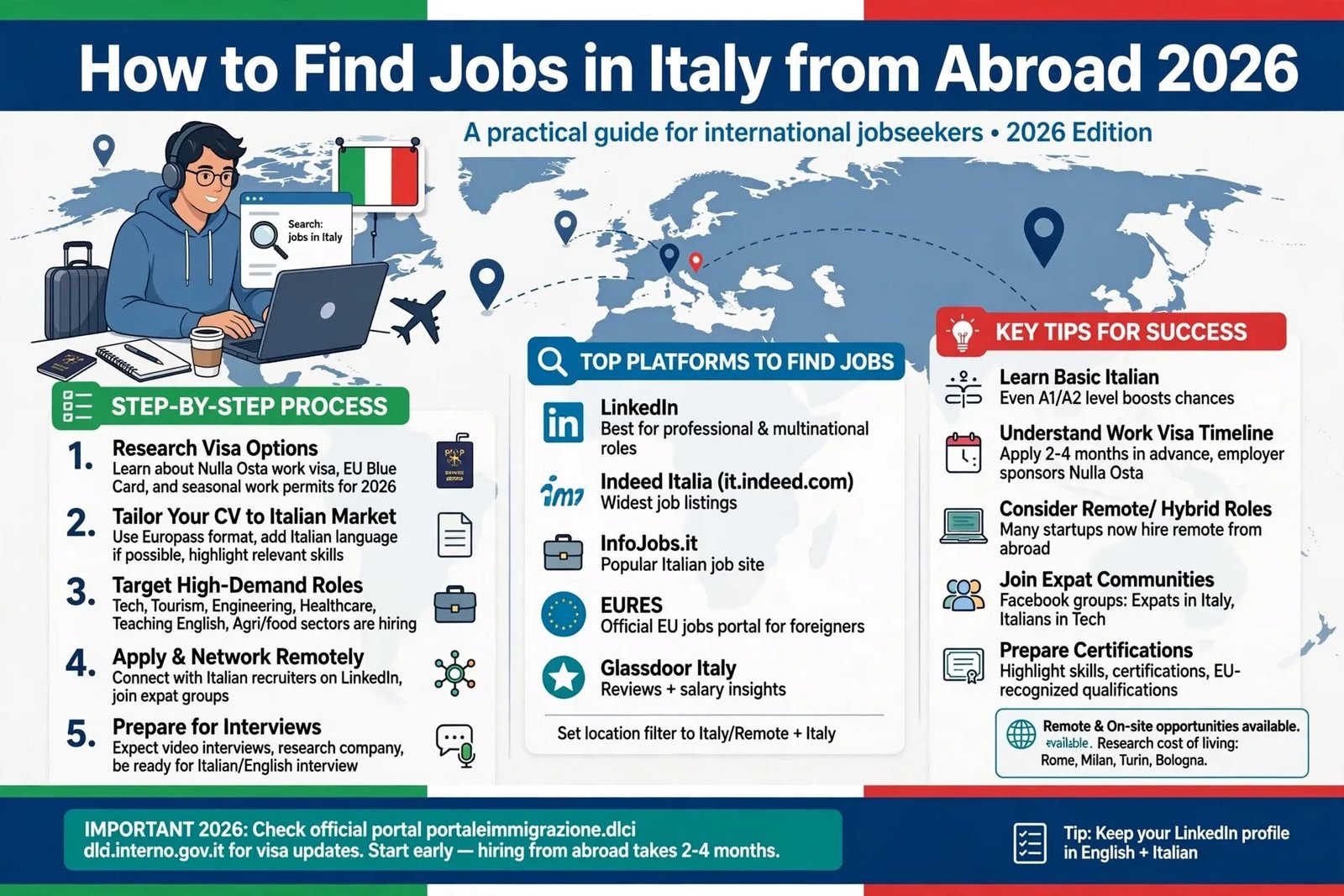
Italy is famous for its food, art, and lifestyle. It is also a real destination for international workers. The country has an aging population and a shortage of skilled and unskilled workers in many industries, from healthcare and construction to hospitality and agriculture. That creates openings for people living outside Italy.
The honest truth is that finding a job in Italy from abroad is possible, but it takes planning. Italian employers often prefer to meet candidates in person, the paperwork can be slow, and visa rules are strict. Scammers also target people who dream of working in Europe.
This guide walks you through the whole process in a practical order: understanding your visa options, preparing your documents, finding real vacancies, applying the Italian way, and arriving legally. Read it from start to finish and you will have a clear roadmap.
Read Also: Jobs in Italy for Foreigners
Can You Really Get a Job in Italy from Abroad?
Yes, but the route depends on your citizenship.
If You Are an EU/EEA or Swiss Citizen
You have the right to live and work in Italy without a visa. You can search for jobs from home, attend interviews, and move once you have an offer. You only need to register your residence with the local municipality (anagrafe) after arriving.
If You Are a Non-EU Citizen
You generally need a job offer from an Italian employer plus authorization to enter Italy for work. The employer usually starts the process, and the system is tied to government quotas. This is the main hurdle for applicants from Asia, Africa, the Americas, and the rest of the world.
Knowing which group you fall into shapes everything else, so settle that first.
Step 1: Understand Italy’s Work Visa System
If you are a non-EU applicant, learn these terms before you apply anywhere.
The Decreto Flussi (Quota System)
Italy issues a Decreto Flussi, a government decree that sets how many non-EU workers can enter each year, broken down by sector and nationality. Recent decrees have opened large numbers of places across multiple years, covering seasonal and non-seasonal work.
Quotas are usually opened through online application windows (often called “click days”). Because dates, quotas, and rules change, always check the official Italian Ministry of Interior and Ministry of Labour websites for the current decree.
Nulla Osta (Work Authorization)
Your future employer applies for a nulla osta al lavoro through the Sportello Unico per l’Immigrazione (One-Stop Shop for Immigration) at the local prefecture. This is the employer’s responsibility. Once approved, it is sent to the Italian embassy or consulate in your country.
The National Visa (Type D)
With the nulla osta approved, you apply for a work visa (Type D) at the Italian consulate in your home country. You will need a valid passport, the nulla osta, proof of accommodation, and other supporting documents.
Permesso di Soggiorno (Residence Permit)
After arriving, you must apply for a permesso di soggiorno within 8 working days. You do this through the post office kit system and a follow-up appointment at the local police headquarters (Questura).
Other Legal Routes Worth Knowing
- EU Blue Card: For highly qualified workers with a university degree and a job offer meeting a minimum salary threshold.
- Highly skilled and specialist categories: Some roles (managers, researchers, specialists) can be exempt from the standard quota system.
- Self-employment and freelance visas: Available in limited circumstances, with strict requirements.
- Digital nomad / remote worker visa: Italy introduced a visa for remote workers who earn income from outside Italy. It carries income and insurance requirements, so check current rules first.
- Study-to-work: Some people enter on a student visa and later convert to a work permit after graduating.
Step 2: Identify In-Demand Jobs
Targeting sectors where employers struggle to hire raises your chances. Common areas of demand include:
- Healthcare and nursing: Nurses, care assistants, and elderly-care workers
- Construction and skilled trades: Electricians, plumbers, welders, masons, and carpenters
- Hospitality and tourism: Chefs, kitchen staff, waiters, hotel workers, especially seasonal
- Agriculture: Farm workers, harvest and greenhouse workers, dairy and livestock work
- Manufacturing and logistics: Factory operators, packers, warehouse workers, drivers
- IT and engineering: Software developers, data specialists, mechanical and automation engineers
- Domestic and caregiving work: Household assistance and elderly care
Be realistic. A strong, specific skill set (a licensed trade, a nursing qualification, a coding portfolio) gives employers a reason to sponsor you.
Step 3: Prepare Your Documents and Profile
Preparation is what separates serious candidates from the crowd.
Build an Italian-Friendly CV
- Keep it to 1 to 2 pages.
- Use a clean format. The Europass CV is widely recognized.
- Include a professional photo only if you are comfortable (it is common but not required).
- List your work history in reverse chronological order, with concrete achievements.
- Add your language levels using the CEFR scale (A1 to C2).
- Add the standard privacy line authorizing data processing under GDPR. Italian employers expect it, for example: “I authorize the processing of my personal data in accordance with the GDPR.”
Write a Short, Specific Cover Letter
Explain who you are, why you want this role, and why you would help this company. Mention your willingness to relocate. Avoid copy-pasted templates, because recruiters notice them quickly.
Get Your Qualifications Recognized
Many non-EU qualifications need to be formally recognized in Italy, especially for regulated professions like nursing, medicine, engineering, and some trades. Contact the relevant Italian professional body early, and ask about:
- Translation of your certificates into Italian
- Legalization or apostille
- A “Declaration of Value” (Dichiarazione di Valore) or comparable recognition, depending on your case
This process can take months, so start before you apply.
Gather Your Core Documents
- Valid passport
- Educational certificates and transcripts
- Work experience letters and references
- Police clearance certificate (when required)
- Language certificates
- Professional licenses
Step 4: Learn Some Italian
You do not need perfect Italian to land every job, but even basic language skills help enormously.
- Manual and seasonal jobs: Basic Italian helps with safety instructions and daily tasks.
- Healthcare, hospitality, and customer-facing jobs: A solid working level (B1 to B2) is often expected.
- IT and international companies: English may be enough, especially in Milan, though Italian remains an advantage.
You can study through free apps, online courses, and language exchange partners. Certificates such as CILS, CELI, or PLIDA prove your level to employers and, in some cases, to immigration authorities. Mentioning “currently studying Italian (A2)” in your CV also signals commitment.
Step 5: Where to Search for Jobs in Italy from Abroad
Use several channels at once. Here are the most useful ones.
Online Job Portals
- LinkedIn: Essential for professional roles. Set your location preference to Italy and turn on “Open to Work” for recruiters.
- Indeed Italia: One of the largest job boards in the country.
- InfoJobs: A popular Italian platform covering many sectors.
- Jobrapido and Subito Lavoro: Aggregators with entry-level and trade vacancies.
- EURES (European Employment Services): An official EU portal that lists jobs across Europe and offers advisers who can help with mobility.
- Glassdoor and Monster Italia: Useful for company research and some listings.
Recruitment and Employment Agencies
Italy has many licensed staffing agencies (agenzie per il lavoro), such as Randstad, Adecco, ManpowerGroup, Gi Group, and Randstad Professional. Many advertise vacancies online, and some run international recruitment programs. A legitimate agency does not charge job seekers a fee for placement.
Company Career Pages
Large employers publish vacancies directly on their websites. Search the career pages of manufacturers, hospital groups, hotel chains, and tech firms. Direct applications often get a faster response than generic board postings.
Networking
- Join LinkedIn groups and Facebook groups for professionals in Italy, but treat any offer found there with caution.
- Connect with recruiters and hiring managers, then send a short, polite message.
- Reach out to alumni, former colleagues, or professional associations with Italian connections.
Sector-Specific Sources
- Seasonal work: Hospitality and agricultural employers hire early for spring and summer, so apply months ahead.
- Healthcare: Regional health authorities and private care providers publish vacancies and sometimes international recruitment drives.
- Skilled trades: Local trade associations and agencies often know which firms need workers.
Step 6: Apply the Smart Way
Tailor Every Application
Match your CV keywords to the job description. If the ad mentions “CNC operator” or “elderly care,” use the same terms where they honestly apply.
Be Clear About Your Visa Situation
Italian employers hire non-EU workers less often because of the paperwork. State upfront that you need work authorization and that you understand the nulla osta process. A candidate who understands the system looks easier to hire than one who ignores it.
Follow Up Politely
If you hear nothing after one to two weeks, send a brief follow-up email. Italian businesses can respond slowly, especially in August and around holidays, so patience helps.
Prepare for Video Interviews
- Test your internet connection and camera in advance.
- Dress professionally and choose a quiet background.
- Research the company and the region where it operates.
- Be ready to explain why Italy, why this role, and when you can start.
- Prepare answers about relocation, accommodation, and how you will handle the language.
Step 7: Beware of Job Scams
Fake offers target hopeful workers every year. Protect yourself with these rules.
- Never pay for a job offer. Legitimate employers do not charge workers to be hired, and the nulla osta application is the employer’s job.
- Be suspicious of offers that promise high pay for little experience.
- Avoid anyone who asks for fees for “guaranteed visas” or “sponsorship.”
- Verify the company: check its website, VAT number (partita IVA), and registered address.
- Do not send passport copies or bank details before confirming the employer is genuine.
- Be careful with offers that arrive only through messaging apps or social media.
- If a recruiter will not do a video call or provide a written contract, walk away.
When in doubt, contact the Italian embassy or consulate in your country, or check official government sources.
Step 8: Know What a Legal Contract Looks Like
Before you accept any offer, make sure the employment contract (contratto di lavoro) is in writing and includes:
- Your job title and duties
- Salary (gross and net) and payment schedule
- Working hours and overtime rules
- Contract type: fixed-term (a tempo determinato) or permanent (a tempo indeterminato)
- The applicable national collective agreement (CCNL), which sets minimum pay and conditions for each sector
- Accommodation arrangements, if the employer provides housing
- Start date and probation period
Italy has minimum standards for rest, leave, and social contributions. If a contract looks vague or far below the sector norm, ask questions before signing.
Step 9: Plan Your Move
Once your visa is approved, think about the practical side.
Housing
Searching from abroad is tricky. Some employers help with accommodation, especially in agriculture and hospitality. Otherwise, consider short-term rentals for your first weeks, then look for a long-term lease after arrival. Never send a deposit for a property you have not verified.
Documents to Complete on Arrival
- Apply for your permesso di soggiorno within 8 working days
- Obtain a codice fiscale (tax code), which you need for contracts, banking, and healthcare
- Register with the national health service (SSN) once eligible
- Open a bank account
- Register your residence at the municipality
Cost of Living
Costs vary widely. Cities like Milan and Rome are far more expensive than smaller towns in the south. Compare your expected salary against local rent and daily expenses before accepting an offer.
Common Mistakes to Avoid
- Mass-applying with the same CV. Quality beats quantity.
- Ignoring visa rules. Arriving on a tourist visa to “look for work” generally does not give you the right to work.
- Skipping Italian entirely. Even a little effort sets you apart.
- Trusting unverified agents. Always check credentials.
- Starting too late. Visa and recognition processes take months.
- Not researching quotas. If your sector or nationality has no quota available, plan an alternative route.
A Realistic Timeline
Every case differs, but a typical path for a non-EU worker may look like this:
- Months 1 to 3: Research, update your CV, start learning Italian, begin qualification recognition.
- Months 3 to 6: Apply to jobs, attend interviews, secure an offer.
- Months 6 to 9: The employer files for the nulla osta, and you wait for approval.
- Months 9 to 12: Visa application, travel, and arrival in Italy.
Seasonal and quota-based roles can move faster or slower depending on the decree. Stay flexible.
Conclusion
Finding a job in Italy from abroad is a process, not a single application. Understand your visa category, choose an in-demand sector, prepare a strong Italian-style CV, learn the language, apply through trusted channels, and watch out for scams. Employers tend to reward candidates who are organized, honest about their situation, and genuinely committed to moving.
Start small today: update your CV, open or refresh your LinkedIn profile, and check the official government page for the latest Decreto Flussi details. Each step brings you closer to working in Italy.
Frequently Asked Questions (FAQ)
1. Can I get a job in Italy without speaking Italian?
Yes, in some cases, especially international companies and IT roles. However, most jobs, particularly in healthcare, hospitality, and trades, expect at least basic Italian, and learning it improves your chances a lot.
2. Can I look for a job in Italy on a tourist visa?
A tourist visa does not give you the right to work. Non-EU citizens generally need a job offer and work authorization before entering for employment.
3. Who pays for the work visa, the employer or the worker?
The employer handles the nulla osta application. The worker normally pays only standard personal costs such as visa fees, translations, and travel. Be wary of anyone who asks for large “sponsorship” payments.
4. How long does it take to get a work visa for Italy?
It often takes several months from the employer’s application to visa issuance, depending on the quota period, the prefecture, and the consulate. Plan for at least 6 to 12 months overall.
5. Which Italian city is best for foreign job seekers?
Milan is strong for business, tech, and design. Rome offers government, tourism, and services. Northern regions such as Lombardy, Veneto, and Emilia-Romagna have many manufacturing and agricultural jobs. Southern regions have strong seasonal tourism and farming work.
6. Is the EU Blue Card worth considering?
If you hold a university degree (or equivalent) and receive a qualifying job offer with a salary above the required threshold, the EU Blue Card can be a good route, with benefits like easier mobility within the EU over time.
7. How do I know if a job offer is genuine?
Check that the company exists, ask for a written contract, avoid paying any fees, and confirm details through official channels. A real employer will be willing to do video interviews and answer questions clearly.
8. Can I work remotely for a foreign company while living in Italy?
Italy has a visa category for remote workers, but it has income, insurance, and other requirements. Check the latest official rules before applying.
Disclaimer: Immigration rules, quotas, and deadlines change often. Always confirm current requirements with the Italian Ministry of Interior, the Ministry of Foreign Affairs, or the nearest Italian embassy or consulate before making decisions.