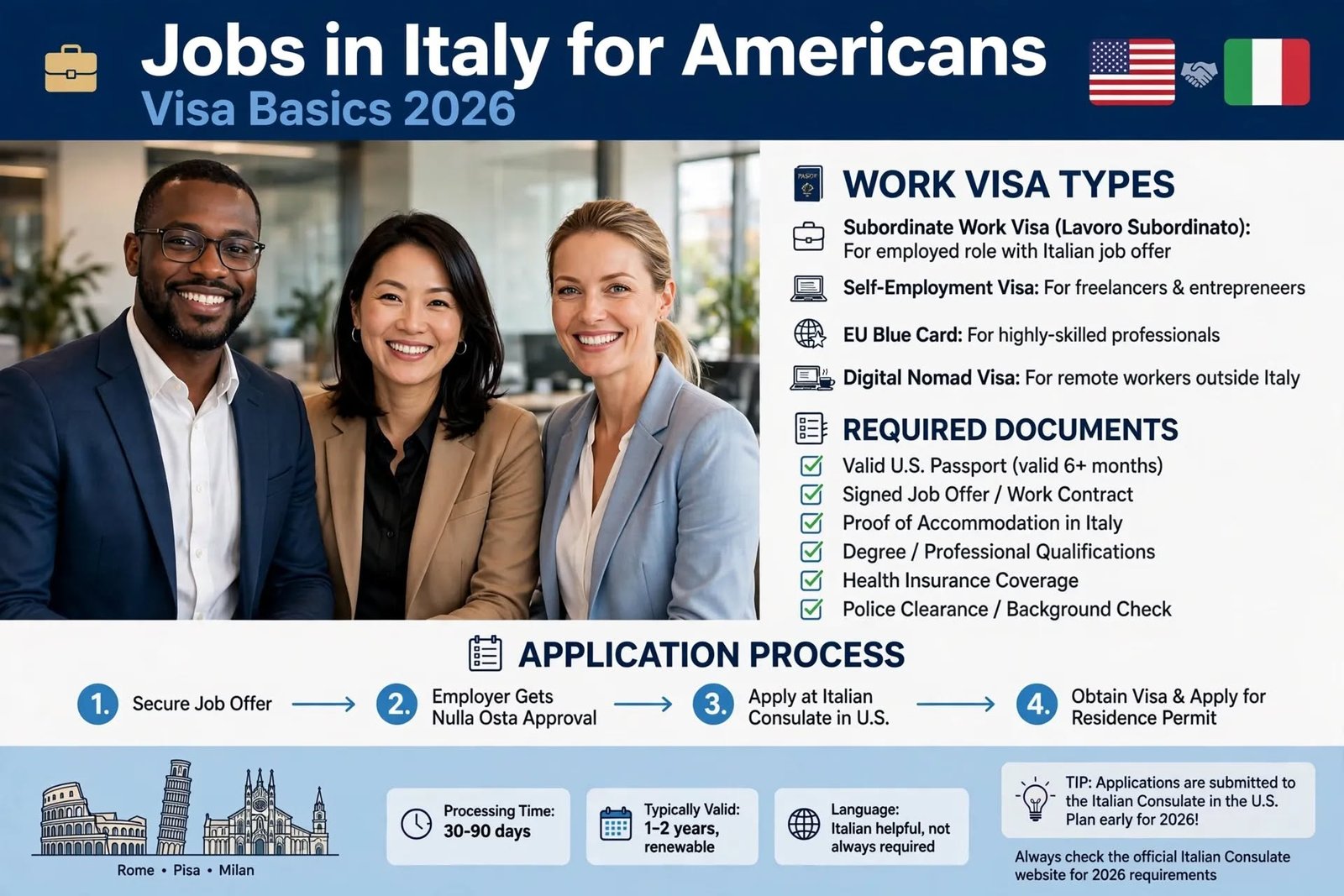
Every year, thousands of Americans picture themselves trading a long commute for espresso at a corner café, weekend trips to the Dolomites, and a calendar full of Italian holidays. The dream is real, and so are the obstacles. Italy is not the easiest country to work in if you hold a US passport, and anyone who tells you that you can just fly over and find a job is leaving out the hard parts.
This guide covers what is realistic. You will learn whether Americans can legally work in Italy, which visas exist, which jobs suit US citizens best, what you can expect to earn, and how to build a plan that works. Whether you are a remote worker, a teacher, a tech professional, or a tradesperson, this is your starting point for jobs in Italy for Americans.
Can Americans Work in Italy?
Yes, but not freely. Italy is part of the European Union and the Schengen Area, and only EU/EEA citizens can live and work there without a work permit. As a US citizen, you are a non-EU national, so you need the right visa and permit before you can legally take a job.
Here is the key distinction:
- Visiting as a tourist: Americans can enter Italy without a visa and stay up to 90 days within any 180-day period. This does not give you the right to work.
- Working or living long-term: You need a national long-stay visa (known as a Type D visa) and then a residence permit, the permesso di soggiorno.
Read Also: Truck Driver and Warehouse Operator Jobs in Italy
One more development to plan for: starting in late 2026, visa-exempt nationals such as Americans will need to register through ETIAS before entering Italy. ETIAS is a travel authorization, not a work permit, but it is part of your pre-trip checklist. feather-insurance
Work Visa Options for Americans in Italy
Choosing the right visa is the most important decision you will make. Here are the main routes.
1. The Quota-Based Work Visa (Decreto Flussi)
This is the standard route for employees. Italy’s Decreto Flussi sets the total number of work visas for non-EU nationals at 497,550 for 2026 to 2028, with 164,850 allocated to 2026. Your employer applies for permission on specific “click days,” and you can only apply once an Italian company has agreed to hire you. globalcitizensolutions
The catch is that these quotas favor certain sectors, such as agriculture, tourism, construction, and trades, and competition for permits is intense. Some immigration lawyers advise against relying on this route. It works best if you have a specific employer who is prepared to handle the paperwork. thelocal
2. The Digital Nomad Visa
For many Americans, this is the most accessible option. Italy launched its digital nomad visa in April 2024, and it sits outside the decreto flussi quotas. It is designed for highly skilled remote workers, employed or freelance, who serve clients or employers outside Italy. thelocal
Typical requirements include:
- Proof of recent experience in your field (at least six months)
- A minimum annual income (check the current figure with your consulate)
- Health insurance and proof of suitable accommodation
- A clean criminal record
The residence permit must be requested within eight days of arrival and can last up to one year, renewable if you still meet the conditions. Importantly, this visa is for working for non-Italian clients, so it does not let you take a job with an Italian company. mondaq
3. Intra-Company Transfer
If you work for a multinational with an Italian office, an internal transfer can be the smoothest route. A type of ICT visa introduced in 2023 lets non-EU workers at Italian-headquartered companies or their subsidiaries apply for a transfer. Many Americans in finance, consulting, engineering, and tech reach Italy this way. thelocal
4. EU Blue Card and Highly Skilled Work
University graduates or experienced specialists with a qualifying job offer and a salary above the national threshold may qualify for an EU Blue Card. This suits software engineers, scientists, and senior managers with an Italian employer sponsoring them.
5. Student Visa Leading to Work
Many Americans study first in Italy, in a master’s program or a language course, and then convert their status to a work permit after graduating. It is slower, but it lets you build language skills, local contacts, and a track record in Italy before you commit.
6. Self-Employment and Investor Visas
Freelancers and entrepreneurs can apply for a self-employment visa, but it falls under the decreto flussi quota system, which limits availability. The investor visa is another option, with minimum investments starting at €250,000 for an Italian startup. It is for wealthy applicants, not typical job seekers. thelocal
Note: The elective residence visa is for financially independent people, including retirees, and it does not allow you to work.
Best Jobs in Italy for Americans
Where do Americans actually find work? These fields offer the best mix of demand and fit.
English Teaching and Language Instruction
English teaching remains the classic entry point. Language schools, private academies, and international schools hire native speakers, especially in Rome, Milan, Florence, and Bologna. Pay is modest, and many positions require a TEFL or CELTA certificate. It can be hard to get visa sponsorship, so many teachers combine teaching with student status or other permits. Check what each school can legally offer you.
Technology and Software Development
Milan, Turin, and Rome have growing tech sectors covering fintech, cybersecurity, automotive software, and AI. American developers and data specialists are valued for English fluency and experience with international teams. Salaries are lower than in the US, but remote-friendly employers and Blue Card routes make this field realistic.
Remote Work for US Companies
For many Americans, the real answer to “jobs in Italy” is a US job performed from Italy. Digital marketers, writers, designers, accountants, customer success managers, and developers can all build a life this way using the digital nomad visa. You keep your US-scale income while enjoying Italian living costs outside the big cities.
Hospitality and Tourism
Italy’s tourism industry is enormous, and it employs people at hotels, resorts, tour companies, and restaurants. Native English speakers are an advantage in guest-facing roles. Seasonal contracts are common, and tourism is one of the sectors prioritized in the annual quota system.
Healthcare and Medical Professions
Nurses, physical therapists, and doctors from the US can work in Italy, but the requirements are demanding. You usually need recognition of your foreign qualifications, registration with the relevant professional body, and Italian language skills. It is a longer process, but demand for healthcare workers is steady.
Engineering, Design, and Manufacturing
Italy is famous for automotive engineering, industrial design, machinery, and fashion. Professionals with experience in mechanical engineering, product design, or supply chain management can find roles in the north, especially around Turin, Bologna, and Milan.
Skilled Trades
Electricians, plumbers, welders, and construction specialists are needed across Italy. Pay is lower than in the US, but trade workers with recognized skills and the right contract can build stable careers.
Creative, Cultural, and Education Roles
Museums, art institutions, international universities, and cultural organizations hire Americans for research, curatorial, and academic positions. The positions are competitive and often tied to fellowships, grants, or university contracts.
Salaries and Cost of Living in Italy
Americans should adjust their salary expectations before they move. Italian wages are generally lower than US wages, especially outside Milan. Rough ranges to keep in mind:
- English teachers: often a modest monthly income, enough for a basic lifestyle in most cities
- Hospitality workers: entry-level pay is low, often supplemented by tips and seasonal work
- Tech and engineering professionals: significantly higher, especially in Milan and with international employers
- Remote workers: paid on their home-country salary, which goes much further outside the big cities
Cost of living varies a lot. Milan and Rome are expensive, mainly because of rent. Smaller cities and southern regions cost far less. Healthcare, public transport, and fresh food are good value compared with the US. Many expats say quality of life matters more than the paycheck, but go in with a realistic budget.
How to Find a Job in Italy as an American
Follow this step-by-step plan.
- Pick your visa route first. Do not start applying until you know whether you are going for a decreto flussi sponsorship, a digital nomad visa, a transfer, or a student route.
- Build a European-style CV. Keep it concise, factual, and professional. Many Italian employers appreciate a clear summary of your skills and languages.
- Learn Italian. Even basic Italian helps your job search, daily life, and bureaucracy. For many roles outside international companies, it is essential.
- Search the right platforms. Use LinkedIn, Indeed Italia, InfoJobs, and sector-specific job boards. Look at company career pages directly, particularly multinationals with Italian offices.
- Network. Join American expat groups, chambers of commerce (such as the American Chamber of Commerce in Italy), and professional associations. Many Italian jobs are filled through referrals.
- Apply from abroad. A job offer from an Italian employer is usually the starting point for a work visa, so start online before you move.
- Prepare your documents. Passport, degree certificates, translations, background checks, and proof of experience can take weeks to collect and legalize.
- Apply at your consulate. Submit your visa application at the Italian consulate that covers your US state, and be ready for strict appointment schedules.
- Register after arrival. Apply for your permesso di soggiorno within the deadline, and get your tax code (codice fiscale).
Taxes, Healthcare, and Paperwork for US Citizens
Moving your career means moving your paperwork too. Here is what Americans should know.
- Taxes: The US taxes its citizens on worldwide income, even when they live abroad. At the same time, you will likely owe taxes in Italy as a resident. Tools such as the foreign tax credit, the foreign earned income exclusion, and the US-Italy tax treaty can reduce double taxation, but you should consult a cross-border tax professional.
- Healthcare: Employees and residents can usually enroll in Italy’s national health service, and many visas require private insurance in the beginning.
- Social security: The United States and Italy have a totalization agreement that can help you avoid paying into two systems and may help preserve your benefits.
- Banking: Opening an Italian bank account requires a tax code, and you may find some American banks restrict services for US citizens. Plan ahead.
Common Mistakes Americans Make
- Arriving on a tourist stay and hoping to find work. This does not give you legal work rights.
- Underestimating the bureaucracy. Appointments, translations, and stamps take time. Patience is part of the Italian experience.
- Ignoring the language. Even in expat-friendly cities, Italian opens doors.
- Choosing a city only for its fame. A cheaper city with better job prospects can be a smarter start than Rome or Florence.
- Skipping professional advice. Immigration rules change often. A qualified immigration lawyer or a consulate can save you months.
A quick note on citizenship: some Americans with Italian ancestry explore citizenship by descent, which would give them full EU work rights. Eligibility rules have been tightened in recent years, so confirm the current requirements with the Italian consulate or a specialist before building a plan around it.
Conclusion
Finding jobs in Italy for Americans takes planning, patience, and the right legal pathway, but it is far from impossible. The digital nomad visa, intra-company transfers, Blue Card jobs, student routes, and sponsored employment each offer a legitimate way in. Whether you teach English in Naples, code in Milan, or work remotely from a village in Puglia, the key is to match your skills to the right visa and to prepare for the bureaucracy ahead.
Start by deciding which route fits your profile, then build your CV, begin learning Italian, and speak to your nearest Italian consulate. Rules and quotas change, so always verify the latest requirements with official sources before you apply. With realistic expectations and good preparation, your Italian chapter can begin sooner than you think.
Frequently Asked Questions (FAQ)
Can Americans work in Italy without a visa?
No. US citizens can visit Italy visa-free for up to 90 days, but that stay does not permit working. You need a work visa and residence permit for legal employment.
What is the easiest way for an American to work in Italy?
For many people, the digital nomad visa is the most accessible, provided you work remotely for non-Italian clients or employers. An intra-company transfer is also straightforward if your employer has an Italian office.
Do I need to speak Italian to get a job in Italy?
Not always. International companies, tech firms, and English-teaching roles may not require fluency. But for most jobs and daily life, Italian is a major advantage.
Can I get a job in Italy first and then apply for a visa?
Yes, and for employment-based visas this is the normal order. An Italian employer applies for authorization, and you then apply for your visa at the consulate.
How much can Americans earn in Italy?
Salaries are generally lower than in the US. Teachers and hospitality staff earn modest wages, while tech professionals and engineers in northern cities earn more. Remote workers keep their foreign income.
Do Americans pay taxes in both countries?
You may have filing duties in both, but tax treaties, credits, and exclusions can limit double taxation. Speak to a cross-border tax advisor.
Disclaimer: Immigration rules, quotas, and requirements change often. Check the Italian Ministry of Foreign Affairs, your local Italian consulate, or an immigration professional before applying.