Last updated: August 29, 2026
Italy’s food processing plants, pharmaceutical packaging lines, logistics warehouses, and export-driven manufacturing sector all depend on one job that rarely gets the spotlight: the packing worker. If you’re researching packing worker jobs in Italy, this guide breaks down what the role actually pays, which sectors are hiring, what the legal visa pathway looks like for non-EU applicants, and how to avoid the recruitment scams that target this exact search term.
This article draws on official Italian government sources (the Ministry of the Interior’s Decreto Flussi decree), independent salary-data providers, and publicly available job-market reporting current as of mid-2026. Figures are presented as ranges because pay varies by region, employer, contract type, and experience — anyone who guarantees you an exact number before you’ve seen a contract should be treated with caution.
What Does a Packing Worker Actually Do?
A packing worker (in Italian, operaio/a addetto/a al confezionamento or imballaggio) prepares finished goods for storage, shipping, or retail sale. Depending on the sector, daily tasks may include:
- Inspecting products for quality before packaging
- Operating or feeding automated packing lines and sealing machines
- Manually boxing, labeling, and palletizing goods
- Weighing and portioning food items
- Preparing pharmaceutical or cosmetic products for shipment
- Basic quality control and defect sorting
- Loading pallets for forklift pickup
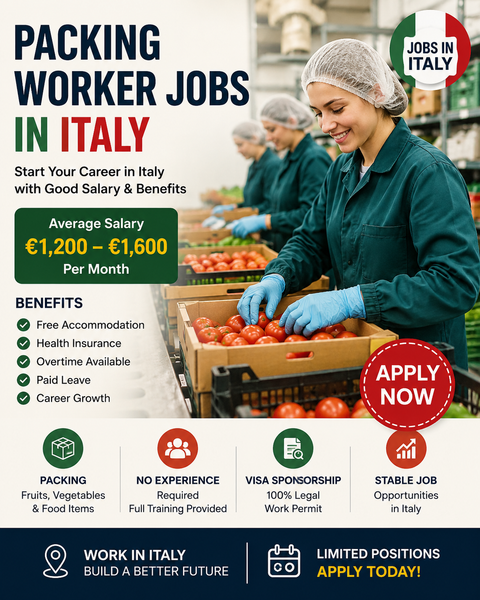
The job is physically active — expect standing for long shifts, repetitive hand movements, and occasional lifting — and most employers provide short on-the-job training rather than requiring prior certification.
Which Industries Hire Packing Workers in Italy?
Italy’s demand for packing labor is spread across several strong export industries:
1. Food and Beverage Processing
Italy is one of the EU’s largest food exporters (pasta, cheese, cured meats, olive oil, wine). Packing lines in Emilia-Romagna, Veneto, and Puglia regularly hire seasonal and year-round staff, especially around harvest periods.
2. Pharmaceuticals and Cosmetics
Lombardy and Lazio host major pharmaceutical and cosmetics manufacturing hubs. These roles typically pay slightly above general warehouse rates because of hygiene and compliance training requirements.
3. E-Commerce and Logistics Warehouses
Fulfillment centers near Milan, Bologna, and Rome hire packing and order-preparation staff, particularly around peak shopping seasons (back-to-school, Black Friday, and the winter holidays).
4. Fashion and Luxury Goods
Northern Italy’s garment and accessories industry needs careful, detail-oriented packing staff for export-ready luxury products.
5. Seasonal Agricultural Packing
Fruit, vegetable, and wine harvest seasons create short-term packing-shed demand, often paid as a daily rate rather than hourly.
How Much Do Packing Workers Earn in Italy?
Salary data for this role varies noticeably between sources, so treat the figures below as a realistic planning range rather than a guarantee:
| Experience Level | Approximate Monthly Gross Pay | Approximate Hourly Rate |
|---|---|---|
| No experience, entry-level | €1,200 – €1,700 | €8.50 – €10.50 |
| 1–3 years’ experience | €1,600 – €2,100 | €10.50 – €13.00 |
| Seasonal agricultural packing | €60 – €90 per day (flat rate) | Varies by contract |
| Supervisor / line lead | €1,900 – €2,800+ | Salaried or hourly |
A few things affect where you land in these ranges:
- Region: Northern Italy (Lombardy, Veneto, Emilia-Romagna) generally pays more than the South, but the cost of living is also higher.
- Contract type: Direct hire (contratto a tempo indeterminato/determinato) versus agency/temp contracts (somministrazione) can carry different benefits and stability.
- Shift patterns: Night and weekend shifts usually carry a premium under Italy’s collective bargaining agreements (CCNL).
- Sector CCNL: Food, logistics, and pharmaceutical sectors each fall under different national labor contracts with their own minimum pay scales.
Always ask an employer which CCNL (collective national labor contract) applies to your role — this is the fastest way to verify a job offer is legitimate and fairly paid.
Can Non-EU Citizens Legally Work as Packing Workers in Italy?
Yes, but only through Italy’s regulated immigration channels. Here’s what’s currently in force.
The Decreto Flussi (Flow Decree)
Non-EU nationals cannot simply apply for a packing job online and move to Italy. Italy controls non-EU labor migration through the Decreto Flussi, an annual/multi-year decree that sets a fixed quota of work-permit slots by sector and country of origin. Under the current 2026–2028 decree, the government has authorized roughly 497,550 total entry slots across the three-year period, split between seasonal work, non-seasonal subordinate employment, and self-employment.
For 2026 specifically, the plan allocates:
- 88,000 seasonal work slots (agriculture and tourism-linked sectors, which includes seasonal packing)
- 76,200 non-seasonal subordinate employment slots (which covers year-round factory and warehouse packing roles)
- A smaller reserved quota for self-employment
Key point for job seekers: you generally need a job offer from an Italian employer before you can apply under this system, and the employer files the initial paperwork (the nulla osta, or work authorization) on your behalf. Application windows (“click days”) open for limited periods and quota slots are consumed quickly on a first-submitted basis, so timing matters.
EU/EEA and Swiss Citizens
If you hold citizenship in an EU/EEA country or Switzerland, you don’t need a Decreto Flussi work permit — you can move to Italy and take a packing job under the same conditions as an Italian citizen, though you’ll still need to register your residence and obtain a codice fiscale (tax code).
A Word of Caution
Because “packing jobs in Italy” is a heavily searched term, it also attracts recruitment scams — fake agencies charging upfront fees for “visa sponsorship” or “guaranteed placement.” Legitimate Italian employers and licensed agencies do not typically require large upfront payments from candidates for a warehouse or packing role. Before paying any fee or sharing passport details, verify the agency is registered and cross-check the job against Italy’s official portals.
How to Apply for Packing Worker Jobs in Italy: Step-by-Step
- Build a simple CV (Europass format is widely accepted) listing any physical-work or factory experience, language ability, and availability dates.
- Search verified channels — Italy’s public employment service (ANPAL / Centri per l’Impiego), EURES (the EU’s official cross-border job portal), and established staffing agencies (agenzie per il lavoro) that are authorized under Italian law.
- Check whether the role is EU-only or open to sponsorship. Many listings for non-EU applicants specify participation in the Decreto Flussi process.
- If you’re a non-EU applicant, confirm your employer will file the nulla osta during an active quota window — this step legally cannot be skipped.
- Prepare basic Italian phrases. Even entry-level roles usually expect functional workplace Italian (A2–B1 level), since safety instructions and supervisor communication are typically in Italian.
- Arrange required documents once an offer is confirmed: valid passport, medical clearance if requested, and — for non-EU hires — the visa application at your local Italian consulate after the nulla osta is approved.
- After arrival, register your presence (dichiarazione di presenza) within 8 working days and apply for your residence permit (permesso di soggiorno) at the local post office, as required by Italian immigration law.
Skills and Requirements Employers Typically Look For
- Basic physical fitness for standing/lifting shifts
- Attention to detail and consistency (quality control matters on packing lines)
- Reliability and punctuality — shift-based manufacturing runs on strict schedules
- Willingness to work rotating or night shifts, especially in food processing
- Basic Italian language ability (higher for supervisory roles)
- Food hygiene (HACCP) certification is a plus for food-sector roles, and some employers will arrange short local training
Frequently Asked Questions
Do I need to speak Italian to get a packing job in Italy? Fluency isn’t always required for entry-level roles, but basic workplace Italian is expected almost everywhere because safety briefings, supervisor instructions, and paperwork are in Italian. Agricultural and seasonal roles are sometimes more flexible on this than factory or pharmaceutical settings.
Is it possible to get a packing job in Italy without a work visa? Not legally, if you’re a non-EU citizen. You need an employer-sponsored process under the Decreto Flussi system, or another valid visa category (such as an EU Blue Card for higher-skilled roles, which packing work does not typically qualify for). EU/EEA/Swiss citizens don’t need this step.
How long does the Italian work visa process take for a packing job? Timelines vary by year and by how quickly quota “click day” slots fill. After the nulla osta is granted, the consular visa and travel process typically takes several weeks to a few months, so it’s realistic to plan well ahead of an intended start date rather than expecting immediate placement.
Are seasonal packing jobs a good entry point? They can be a practical way to gain Italian work experience and local references, particularly in agriculture, but seasonal contracts are temporary by design and pay is often a flat daily rate rather than an hourly wage with full-year benefits.
How can I tell if a “packing jobs in Italy” listing is a scam? Be cautious of any posting that asks for payment before you’ve been formally hired, promises guaranteed visa approval, or won’t confirm the actual employer’s name and CCNL. Cross-check listings against EURES or the employer’s own official website.
Final Thoughts
Packing worker jobs in Italy are a real and ongoing part of the country’s food, logistics, pharmaceutical, and manufacturing economy, with entry-level pay generally falling in the €1,200–€2,100 monthly range depending on sector, region, and experience. For non-EU applicants, the legal pathway runs through an employer-sponsored process under the Decreto Flussi — there is no shortcut around this system, and treating any offer that bypasses it as a red flag will save you time, money, and risk. Start with verified channels like EURES, confirm the applicable labor contract (CCNL), and build your application around a genuine, checkable job offer.