
Italy welcomes over 60 million international visitors every year, and behind every good stay is a hotel team working around the clock — front desk agents, housekeepers, chefs, concierges, and managers. If you’re exploring hotel jobs in Italy, this guide breaks down the most in-demand roles, realistic salary ranges, the regions hiring the most staff, visa requirements for non-EU applicants, and a step-by-step plan for landing your first offer.
This article draws on publicly available Italian labor market data, tourism board reports, and standard EU/Italian immigration procedures. It is written for informational purposes; always confirm current visa quotas and wage figures with Italy’s official government portals before making relocation decisions.
Table of Contents
- Why Work in the Italian Hotel Industry
- Most In-Demand Hotel Jobs in Italy
- Average Hotel Salaries in Italy
- Best Regions and Cities for Hotel Jobs
- Requirements to Work in an Italian Hotel
- Can Foreigners Get Hotel Jobs in Italy? (Visa Guide)
- How to Apply for Hotel Jobs in Italy
- Skills That Make You More Hireable
- Frequently Asked Questions
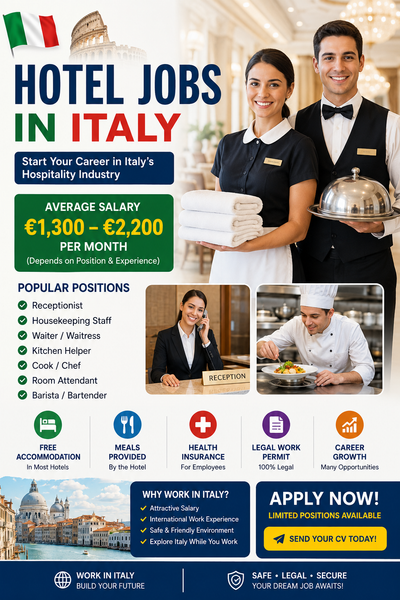
Why Work in the Italian Hotel Industry
Italy’s hospitality sector is one of the largest employers in the country, driven by year-round tourism to cities like Rome, Venice, Florence, and Milan, plus seasonal surges along the Amalfi Coast, in Tuscany, and across the Italian Alps. For job seekers, this creates two advantages:
- Consistent demand. Hotels need staff for reception, housekeeping, food and beverage, and maintenance regardless of the economic cycle.
- Career mobility. Many general managers and department heads started in entry-level roles such as bellhop, waiter, or front desk agent, making hospitality one of the more accessible paths into management.
Working in an Italian hotel also offers exposure to multilingual guests, European service standards, and — for many — a genuine passion for Italian hospitality culture, known locally as ospitalità.
Most In-Demand Hotel Jobs in Italy
Below are the roles Italian hotels consistently recruit for, especially ahead of the spring-to-autumn tourist season.
1. Front Desk Receptionist (Receptionist d’Albergo)
Handles check-in/check-out, guest requests, and reservations. Fluency in Italian plus at least one other language (English, French, or German) is typically required.
2. Housekeeping Staff (Cameriera ai Piani)
Responsible for room cleaning and turnover. One of the highest-volume hiring categories, especially in larger hotels and resorts.
3. Chef and Kitchen Staff (Cuoco/Aiuto Cuoco)
Includes head chefs, sous chefs, and kitchen assistants. Culinary experience or a diploma from a hospitality institute (istituto alberghiero) is highly valued.
4. Waitstaff and Bartenders (Cameriere/Barista)
Restaurant and bar service within the hotel. Seasonal hotels hire heavily for these roles during peak months.
5. Concierge
A guest-facing role focused on recommendations, bookings, and problem-solving. Strong language skills and local knowledge are essential.
6. Hotel Manager / Assistant Manager (Direttore d’Albergo)
Oversees daily operations, staffing, budgets, and guest satisfaction. Usually requires several years of hospitality experience or a degree in hospitality management.
7. Maintenance and Facility Staff
Handles repairs, pool and garden upkeep, and general building maintenance — a steady, often overlooked hiring category.
8. Event and Wedding Coordinator
Common in resort hotels and countryside estates (agriturismi) that host weddings and corporate events.
Average Hotel Salaries in Italy
Salaries vary by region, hotel star-rating, and experience level. The figures below are general estimates based on typical Italian hospitality wage bands and should be verified against current collective labor agreements (CCNL Turismo).
| Role | Estimated Monthly Salary (Gross) |
|---|---|
| Housekeeping Staff | €1,200 – €1,500 |
| Front Desk Receptionist | €1,300 – €1,700 |
| Waitstaff / Bartender | €1,200 – €1,600 |
| Chef / Kitchen Staff | €1,400 – €2,200 |
| Concierge | €1,500 – €1,900 |
| Assistant Manager | €2,000 – €2,800 |
| Hotel General Manager | €3,000 – €5,000+ |
Northern cities like Milan and hotels in luxury coastal resorts generally pay above these ranges, while smaller towns in the south tend to sit at the lower end.
Best Regions and Cities for Hotel Jobs in Italy
- Rome & Lazio — Year-round demand due to constant tourist and business travel.
- Venice & Veneto — Heavy seasonal hiring, especially spring through autumn.
- Florence & Tuscany — Strong demand in boutique hotels and countryside agriturismi.
- Milan & Lombardy — Business hotels with higher salaries and international clientele.
- Amalfi Coast & Campania — Intense seasonal hiring from April to October.
- Italian Alps (Trentino-Alto Adige, Valle d’Aosta) — Winter season hiring for ski resort hotels.
- Sicily & Sardinia — Growing hospitality sector tied to expanding summer tourism.
Requirements to Work in an Italian Hotel
While requirements vary by employer, most Italian hotels look for:
- Basic to conversational Italian (essential for guest-facing roles)
- English proficiency (often mandatory in tourist-heavy regions)
- A hospitality diploma or relevant experience for skilled roles (chefs, managers)
- A valid right to work in Italy (EU citizenship, or a work visa/permit for non-EU nationals)
- For seasonal roles, flexibility to work weekends, holidays, and split shifts
Can Foreigners Get Hotel Jobs in Italy? (Visa Guide)
Yes, but the path differs depending on your citizenship.
EU/EEA/Swiss citizens can work in Italy without a visa or work permit, though registering a residence (residenza) is typically required for longer stays.
Non-EU citizens generally need one of the following:
- Decreto Flussi (Flow Decree) Work Permit — Italy sets an annual quota for non-EU seasonal and non-seasonal workers, including hospitality roles. Employers must sponsor the application.
- Elective or Long-Term Visa Categories — Rarely used for hotel work specifically, but relevant if you already hold Italian ancestry (jure sanguinis) or another qualifying visa.
- Working Holiday Visas — Available to citizens of a limited number of countries with bilateral agreements with Italy.
Because non-EU hiring quotas open only during specific application windows each year, always check the official Italian Ministry of Interior or your nearest Italian consulate for current deadlines before applying to jobs that require sponsorship.
How to Apply for Hotel Jobs in Italy
- Build a European-style CV. Include a professional photo, clear work history, and language proficiency levels (A1–C2 scale).
- Target the right platforms. Search hotel group career pages directly (Italian hotel chains and international brands operating in Italy), plus hospitality-focused job boards and LinkedIn.
- Apply directly to hotels for seasonal roles. Many independent hotels, especially in coastal and mountain resort towns, hire directly rather than through large job boards.
- Prepare for a practical interview. Hospitality interviews often include role-play scenarios (handling a guest complaint, for example).
- Confirm your legal right to work before accepting an offer, especially if you are a non-EU applicant relying on employer sponsorship.
- Network through hospitality schools and associations, which often post seasonal openings before they reach public job boards.
Skills That Make You More Hireable
- Multilingualism — Italian plus English is close to a baseline requirement; add French, German, Spanish, or Mandarin for a real edge.
- Guest service mindset — Patience, warmth, and problem-solving under pressure matter more than a polished resume.
- Digital literacy — Familiarity with property management systems (PMS) like Opera or Fidelio is a strong plus for front-office roles.
- Flexibility — Willingness to work seasonal contracts, split shifts, and peak-season overtime significantly widens your job options.
- Formal training — A diploma from an istituto alberghiero or an internationally recognized hospitality program strengthens applications for management-track roles.
Frequently Asked Questions
Do I need to speak Italian to work in a hotel in Italy? Not always. Some international hotel chains in major cities operate primarily in English, but conversational Italian significantly increases your job options, especially outside large tourist hubs.
Are hotel jobs in Italy seasonal or year-round? Both exist. Cities like Rome, Milan, and Venice offer more year-round positions, while coastal and mountain resorts hire heavily for defined summer or winter seasons.
What is the easiest hotel job to get in Italy as a beginner? Housekeeping and entry-level food and beverage roles typically have the lowest barrier to entry and the highest hiring volume.
Can I get a hotel job in Italy without prior experience? Yes, for entry-level roles such as housekeeping, kitchen assistant, or seasonal waitstaff. Front-desk and management roles usually require prior hospitality experience or formal training.
How do non-EU citizens get sponsored for hotel jobs in Italy? Through Italy’s Decreto Flussi work permit system, where an employer applies on the worker’s behalf during a designated annual quota window. Always verify current requirements with an Italian consulate.