Italy is known for its food, fashion, and history. It is also a country with a serious labour shortage. An ageing population, a shrinking workforce, and growing demand in farming, tourism, healthcare, construction, and technology mean that Italian employers need workers from abroad.
The government has acknowledged this. Under its latest quota decree, Italy plans to admit hundreds of thousands of non-EU workers over the next few years. That makes jobs in Italy for foreigners a realistic goal, as long as you understand how the system works.
The system is also strict. Visa rules, quota deadlines, and paperwork trip up many applicants, and scammers target hopeful job seekers. This guide explains where the opportunities are, how legal hiring works, where to look, and how to put together an application that gets noticed.
Can Foreigners Really Work in Italy?
Yes, but your route depends on your nationality.
If You Are an EU/EEA Citizen
You can live and work in Italy without a visa or work permit. You only need to register your residence if you stay longer than three months. Your job search is the same as an Italian’s.
If You Are a Non-EU Citizen
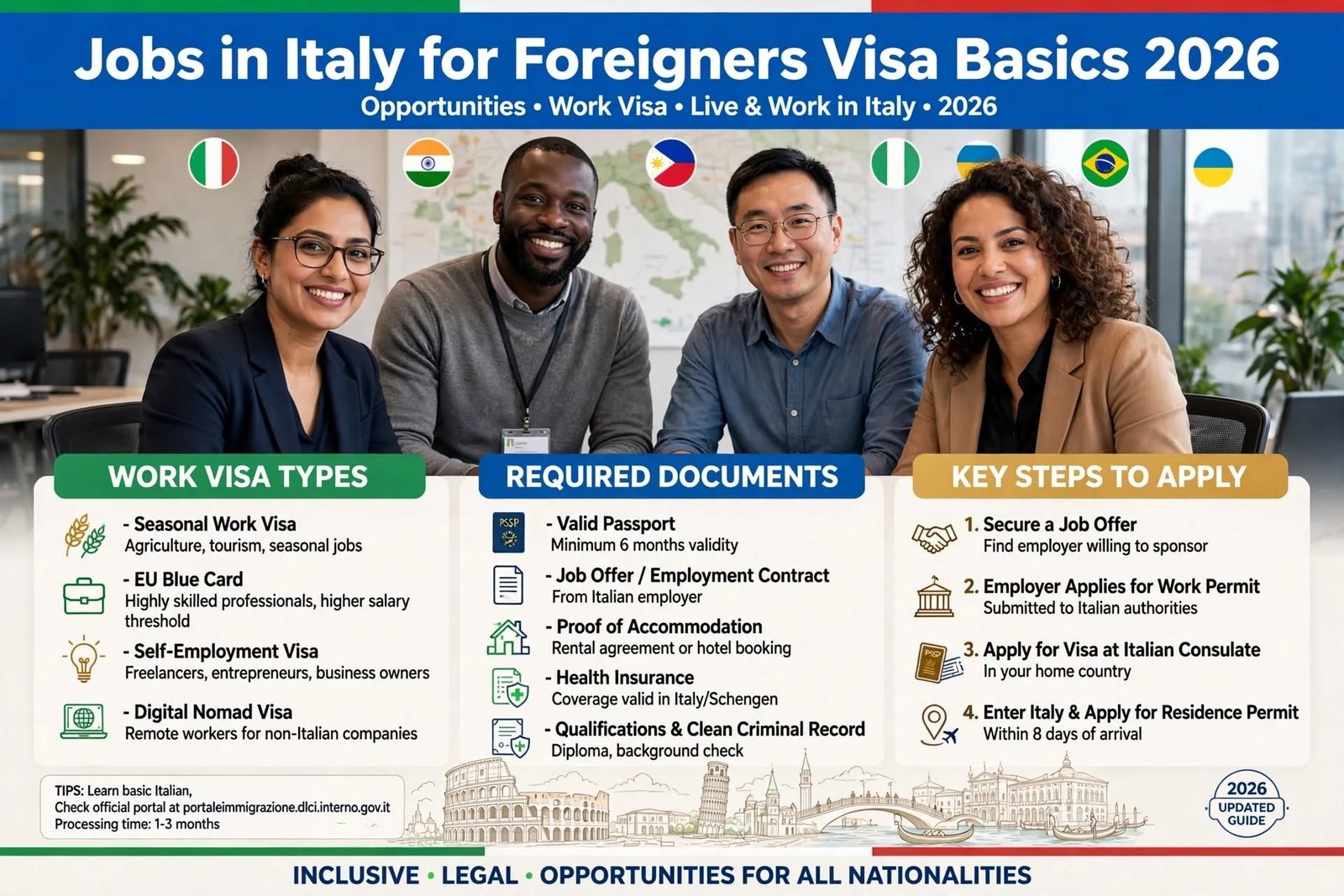
Things are more structured. In most cases you need:
- A job offer from an Italian employer
- A work authorisation (nulla osta) approved in Italy
- A national work visa (type D) issued by the Italian consulate in your country
- A residence permit (permesso di soggiorno) after you arrive
The key point is that for most non-EU workers, the employer starts the process, not the worker. You cannot simply fly to Italy on a tourist visa and start working.
Read More: Chef and Hospitality Jobs in Italy
Understanding the Decreto Flussi (Italy’s Work Quota System)
The Decreto Flussi is the Italian government’s decree setting how many non-EU workers may enter the country for work each year. The current decree covers 2026–2028 and authorises roughly 497,550 entries over the three years, with about 164,850 places for 2026, according to published summaries of the decree.
How the Quotas Work
Quotas are divided into categories:
- Seasonal work, mainly agriculture and tourism
- Non-seasonal employed work
- Domestic and family care work
- Self-employment (small numbers)
Employers apply online on specific “click days.” Popular categories have historically filled very quickly, and applications are processed in order of submission.
What This Means for You
- Your employer must submit the application. You cannot apply yourself.
- Timing matters, so start your job search months before the click days.
- If a quota category fills up, you may need to wait for the next year’s round.
- Italy has said it wants to reduce reliance on the click-day system and expand out-of-quota routes, so check the official Ministry of the Interior and Ministry of Foreign Affairs websites for current rules.
Types of Work Visas and Permits for Italy
1. Seasonal Work Visa
Valid for short periods, usually in agriculture and tourism. It is one of the most accessible routes, and many people use it to get a foot in the door.
2. Non-Seasonal Employment Visa
For longer-term contracts in sectors like manufacturing, construction, logistics, and hospitality. This route needs an employer willing to sponsor you through the quota system.
3. EU Blue Card
Designed for highly qualified professionals such as engineers, IT specialists, and doctors. It requires a university degree (or equivalent experience in some fields), a job offer, and a salary above a set threshold. The Blue Card sits outside the standard quota, which makes it attractive for skilled workers.
4. Intra-Company Transfer
For employees of a multinational who are moved to an Italian branch. Also outside the quota.
5. Self-Employment / Freelance Visa
For entrepreneurs and independent professionals. Requirements include proof of qualifications, funds, and housing, and the number of places is limited.
6. Student Visa with Work Rights
Non-EU students can usually work part-time during their studies, and some can convert their permit to a work permit afterwards. This is a long-term but legitimate path.
7. Italy’s Digital Nomad / Remote Worker Route
Italy introduced a visa for highly skilled remote workers earning from non-Italian clients. Requirements are specific, so confirm the latest conditions before you plan around it.
Important: Rules, salary thresholds, and quotas change. Always verify with an Italian embassy, consulate, or the official government portals.
Which Sectors Are Hiring Foreigners in Italy?
Some industries rely heavily on foreign workers because of persistent labour gaps.
Agriculture and Farming
From vineyards in Tuscany to fruit farms in the south, agriculture is the biggest employer of seasonal foreign workers. Roles include harvesting, packing, dairy work, and greenhouse labour.
Tourism and Hospitality
Italy is one of the world’s top travel destinations. Hotels, restaurants, resorts, and cruise-linked services hire waiters, cooks, housekeepers, and front-desk staff, especially from spring to autumn.
Healthcare and Elderly Care
Italy’s population is one of Europe’s oldest. Demand is high for nurses, care assistants, and home carers. Foreign qualifications must usually be recognised first.
Construction and Skilled Trades
Electricians, plumbers, bricklayers, welders, and carpenters are in steady demand, especially in northern industrial regions.
Manufacturing and Logistics
Northern Italy has a strong industrial base in machinery, automotive parts, food processing, and fashion production. Warehousing and delivery roles are growing too.
IT and Technology
Software developers, data analysts, and cybersecurity professionals can find roles in Milan, Turin, Rome, and Bologna. English-speaking tech jobs exist, particularly in startups and international companies.
Domestic and Family Care
Live-in and daytime carers for families are in demand across the country, and this category has its own dedicated quota.
How to Find Jobs in Italy as a Foreigner
Online Job Portals
- LinkedIn, best for professional, corporate, and international roles
- Indeed Italia, broad coverage across all job types
- InfoJobs, Subito Lavoro, and Jooble, popular for general and trade jobs
- EURES (the European job mobility portal), good for roles open to international applicants
- Official regional employment centres (Centri per l’Impiego), useful once you are in Italy
Company Websites
Many Italian and multinational companies list vacancies in a “Lavora con noi” (Work with us) section. Large hotel groups, manufacturers, and logistics firms often recruit directly.
Recruitment Agencies
Agencies such as Randstad, Adecco, ManpowerGroup, and Gi Group operate across Italy. Legitimate agencies never charge candidates a fee for placing them in a job.
Networking
Italy runs heavily on personal contacts. Join professional groups, attend job fairs, and reach out to expats and professionals in your field. A short, polite message can open more doors than a hundred cold applications.
Learn Where the Demand Is
- Milan and Lombardy: finance, IT, fashion, manufacturing
- Turin and Piedmont: automotive, engineering, food
- Emilia-Romagna: machinery, logistics, agri-food
- Veneto: manufacturing, tourism
- Rome and Lazio: government-linked services, tourism, tech
- Southern regions: agriculture and seasonal tourism
Step-by-Step: How to Apply and Get Hired in Italy
- Choose your sector and visa route. Decide whether you fit the seasonal, skilled (Blue Card), or general employment category.
- Prepare your documents. Passport, CV, qualification certificates, and reference letters.
- Search and apply for jobs. Target employers who are open to hiring from abroad.
- Interview. Often by video call. Prepare to discuss your experience and your willingness to relocate.
- Employer applies for the nulla osta. Once you have an offer, your employer submits the application through the official Italian portal.
- Apply for your visa. After the nulla osta is approved, you apply at the Italian consulate in your country.
- Travel to Italy. Typically, you must apply for your residence permit within 8 days of arrival.
- Complete the residence permit process. This usually includes a fingerprinting appointment and paperwork at the local police office (Questura) or post office.
- Get your tax code (codice fiscale). You will need it for contracts, banking, and healthcare.
Realistic Timelines
The process can take several months from job offer to arrival. Be patient and plan ahead.
Writing an Italian-Style CV and Cover Letter
CV Tips
- Keep it 1–2 pages and clear.
- Use the Europass format or a clean, similar layout.
- Include contact details, work experience, education, languages, and skills.
- Add a line authorising data processing, as Italian employers expect this under privacy law.
- A professional photo is optional and increasingly uncommon in international companies.
Cover Letter Tips
- Address the company directly.
- Explain why you want to work in Italy and with that employer.
- Mention any Italian language skills, even if basic.
- Keep it concise and polite.
Language Matters
English is enough in some multinational and tech jobs, but Italian opens many more doors, especially in hospitality, healthcare, and trades. Even A2–B1 level shows commitment and helps you settle in.
Salary Expectations and Working Conditions
Pay varies widely by sector, region, and experience.
- Employment in Italy is governed by national collective labour agreements (CCNL), which set minimum pay, hours, and leave for each industry.
- Northern regions generally pay more than the south.
- Skilled professionals, such as IT and engineering specialists, earn significantly more than seasonal or entry-level workers.
- Employees typically receive paid holidays, sick leave, and social contributions, and the standard work week is around 40 hours.
- Many contracts include a 13th (and sometimes 14th) month salary, a common Italian benefit.
Always confirm your contract details, including pay, hours, accommodation, and notice period, before you travel.
Avoiding Job Scams and Visa Fraud
Unfortunately, fake offers are common, and the desire to work abroad makes people vulnerable.
Warning signs:
- A “recruiter” asks you to pay money for a job guarantee or a visa
- Promises of guaranteed visas or guaranteed quota slots
- Job offers with no interview and unrealistically high pay
- Communication only through messaging apps, with no company email or website
- Requests for your passport copy or bank details too early
How to protect yourself:
- Verify the company through its official website and Italian business registry
- Confirm any job offer directly with the employer
- Remember that the employer applies for the nulla osta, and you do not pay for the quota slot
- Use only official government websites and Italian consulates for visa information
- Report suspicious offers to local authorities
Living in Italy: Practical Tips for New Arrivals
- Housing: Rents are highest in Milan and Rome. Smaller cities are cheaper. Never pay a deposit before seeing a property or signing a proper contract.
- Healthcare: Legal residents can register with the national health service (SSN).
- Banking: Opening an account requires your codice fiscale and residence documents.
- Culture: Greetings, punctuality, and respect for hierarchy matter. Lunch breaks are valued, and relationships are important in business.
- Learning Italian: Take a language course early. Many municipalities and organisations offer affordable or free classes for migrants.
Long-Term Prospects: From Work Permit to Permanent Residence
Many foreigners start with a temporary contract and build a stable life in Italy.
- After five years of legal residence, you may apply for an EU long-term residence permit, subject to income and other requirements.
- Italian citizenship by residence generally requires several years of legal residence plus language and income conditions. Check the current requirements.
- Professional growth, language skills, and a clean record of compliance with immigration rules all help your case.
Conclusion
Finding jobs in Italy for foreigners is realistic if you plan carefully and stay informed. The country needs workers in agriculture, hospitality, healthcare, construction, manufacturing, and technology, and its quota system leaves room for thousands of non-EU workers each year.
The key steps are simple. Choose the right sector and visa route, search through trusted channels, build a solid CV, and let your employer handle the official work permit process. Stay alert for scams, and never pay for a job or a visa slot. Learn some Italian as early as you can, because it makes everything easier.
With patience and the right preparation, Italy can be more than a holiday destination. It can be the place where your career moves forward.
Frequently Asked Questions (FAQ)
1. Can I move to Italy without a job offer?
Generally, no. Most non-EU citizens need a job offer and an approved work authorisation before they can get a work visa. Some limited routes, such as study or specific freelance visas, exist, but a tourist visa does not allow you to work.
2. What is the Decreto Flussi?
It is the Italian government’s decree that sets annual quotas for non-EU workers entering Italy for seasonal, non-seasonal, and self-employed work. Employers apply for the quota slots on specific click days.
3. Which jobs are easiest for foreigners to get in Italy?
Seasonal agricultural and tourism jobs, domestic and family care work, and skilled trades such as construction are among the more accessible categories, because they have persistent labour shortages.
4. Do I need to speak Italian?
Not always. Some tech and international company roles work in English. However, for most jobs, especially in hospitality, healthcare, and trades, Italian is strongly preferred and helps you integrate.
5. Can my employer sponsor my visa?
Yes. In Italy, the employer submits the nulla osta application on your behalf. You do not apply for this stage yourself.
6. How long does the process take?
It varies by category and workload, but the full process from job offer to arrival often takes several months.
7. Is the EU Blue Card a good option?
For qualified professionals with a degree and a job offer above the salary threshold, yes. It sits outside the standard quota and offers certain mobility benefits within the EU.
8. Can I bring my family?
Many work permit holders can apply for family reunification after meeting income and housing requirements. Conditions depend on your permit type.
9. How much does it cost to apply?
Official visa and permit fees apply, but you should never pay recruiters for a job or a quota slot. Check current fees on the official consulate and government websites.
10. Where can I get reliable information?
Use the websites of the Italian Ministry of Foreign Affairs, the Ministry of the Interior, your nearest Italian embassy or consulate, and the EURES portal.
Disclaimer: Immigration rules, quotas, and salary thresholds change often. Treat this article as a general guide and verify current requirements with official Italian authorities before making decisions.