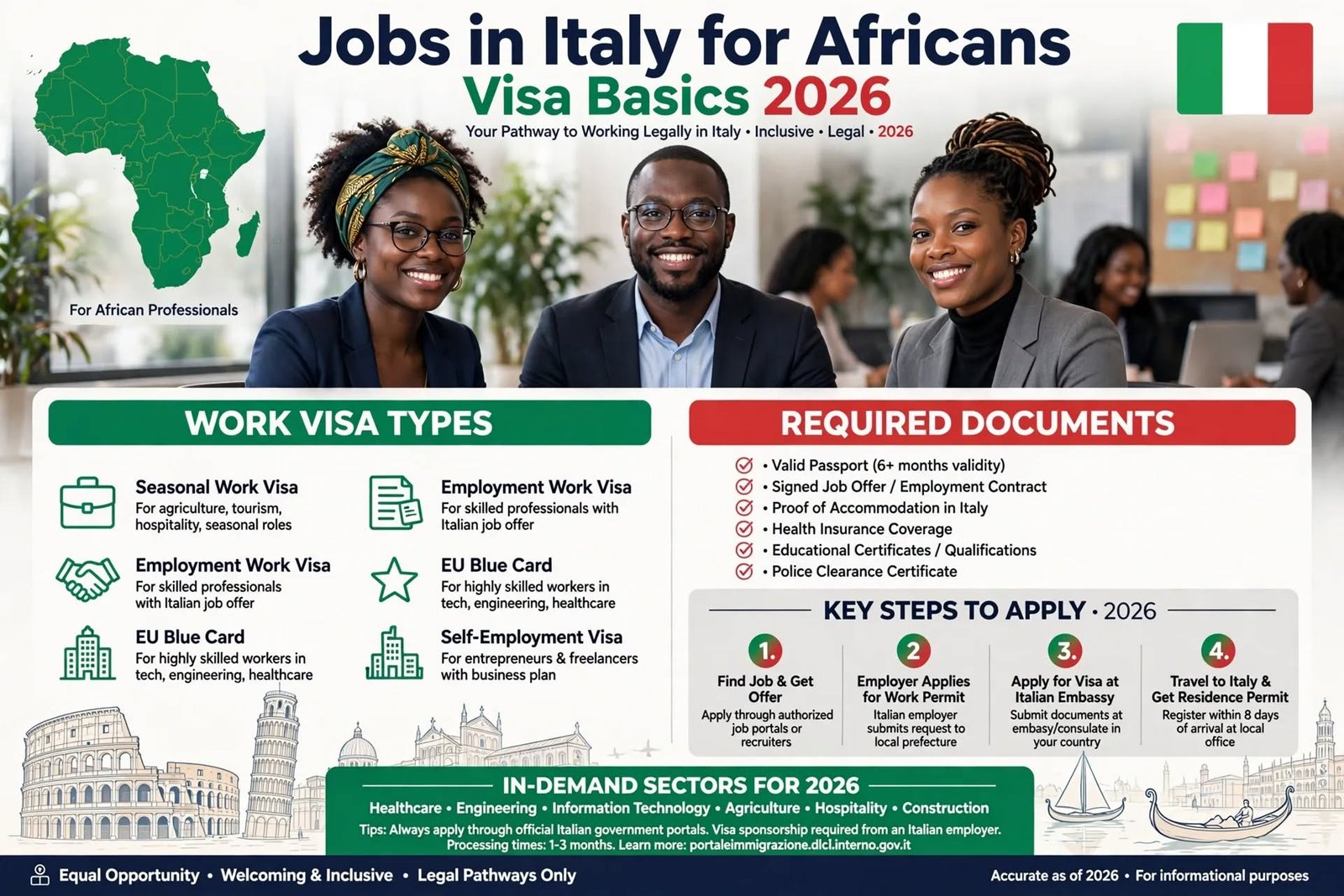
Every year, thousands of people from Africa search for jobs in Italy for Africans, and the interest makes sense. Italy has an ageing population and a shrinking workforce. It also has entire industries, from farming to elder care, that struggle to find enough workers. For many Africans, that gap looks like a genuine chance to build a better life in Europe.
But there is also a lot of misinformation online. Fake job offers, “guaranteed visa” promises and agents who charge thousands of dollars for nothing have cost many hopeful applicants their savings.
This guide gives you the honest picture. You will learn which sectors hire foreign workers, how the legal work-visa system works, what salaries to expect, and how to protect yourself from scams. Immigration rules change often, so always confirm the final details on official Italian government websites before you act.
Why Italy Needs Foreign Workers
Italy has one of the oldest populations in Europe. More people are retiring than entering the job market, and employers in several industries have openly said they cannot fill positions with local workers alone.
The Italian government has responded by approving large quotas for non-EU workers. Under the most recent planning cycle, the quota covers nearly half a million entries over three years (2026–2028). These numbers matter because they show that legal migration for work is part of Italy’s long-term plan, not a loophole.
Read Also: Jobs in Italy for Indians, Pakistanis and Bangladeshis
Sectors with the strongest demand include:
- Agriculture (harvesting, greenhouse and livestock work)
- Tourism and hospitality (hotels, restaurants, resorts)
- Construction and skilled trades
- Healthcare and elder care
- Logistics, warehousing and driving
- Manufacturing and food processing
Can Africans Legally Work in Italy?
Yes, but only through the proper legal channels. Italy does not allow you to simply arrive and look for work on a tourist visa. As a non-EU citizen, you generally need a job offer from an Italian employer, an approved work authorization, and a visa issued before you travel.
The Main Legal Routes
- The Decreto Flussi (quota system): the most common route for non-EU workers, covering seasonal and non-seasonal jobs.
- EU Blue Card: for highly qualified professionals with a university degree and a qualifying job offer.
- Study-to-work route: studying in Italy, then converting your student permit into a work permit.
- Self-employment and freelance visas: limited and requiring proof of funds and qualifications.
- Family reunification: if a close relative already lives in Italy legally.
For most job seekers from Africa, the Decreto Flussi is the realistic starting point.
Understanding the Decreto Flussi
The Decreto Flussi is the government decree that sets how many foreign workers can enter Italy each year, by job category and sometimes by nationality.
How It Works Step by Step
- An Italian employer applies. The employer, not you, submits the request for a foreign worker through the official online portal during a set window, often called a “click day.”
- The authorities review the request. The local immigration office (the Sportello Unico per l’Immigrazione) checks the application and the employer’s eligibility.
- A nulla osta is issued. This is the work authorization. It means Italy approves your hiring.
- You apply for the visa. With the nulla osta, you apply at the Italian embassy or consulate in your country.
- You travel to Italy. After arrival, you must sign the residence contract and apply for your permesso di soggiorno (residence permit) within eight days.
Important Facts to Remember
- The quotas are limited, and the best slots fill quickly.
- Some quotas give priority to citizens of countries that have cooperation agreements with Italy. These lists change, so check whether your country is currently included.
- A real employer must be involved. Nobody can buy a nulla osta on your behalf.
Best Jobs in Italy for Africans
1. Agricultural and Farm Work
Agriculture is the biggest entry point for foreign workers. Italy’s vineyards, olive groves, fruit farms, greenhouses and dairy operations need seasonal and year-round labor.
- Typical roles: fruit and vegetable picker, greenhouse worker, grape harvester, farm hand, dairy worker
- Contract type: seasonal or fixed-term, sometimes renewable
- Requirements: physical fitness; experience helps but is often not essential
- Regions with high demand: Puglia, Sicily, Calabria, Emilia-Romagna, Veneto, Piedmont
2. Hospitality and Tourism
Italy welcomes tens of millions of visitors a year, and hotels, resorts and restaurants hire heavily from spring to autumn.
- Typical roles: kitchen assistant, dishwasher, housekeeper, waiter, hotel porter
- Helpful skills: basic Italian or English, a friendly attitude, willingness to work shifts
3. Caregiving and Elder Care
With so many elderly residents, families and care homes need reliable assistants.
- Typical roles: home caregiver (badante), care home assistant, domestic helper
- Helpful skills: patience, empathy, and learning Italian quickly
- Note: formal healthcare roles, like nursing, require recognition of your qualifications
4. Construction and Skilled Trades
Builders, electricians, plumbers, welders and masons are in short supply.
- Typical roles: laborer, bricklayer, electrician, plumber, welder
- Tip: certificates and proven experience raise your chances and your pay
5. Factory, Packing and Logistics
Food processing, packaging and warehouse operations hire steadily, especially in northern Italy.
- Typical roles: packer, machine operator, forklift driver, warehouse assistant
- Tip: a forklift or machinery certificate can set you apart
6. Skilled Professional Roles
If you hold a degree or specialized training, you can aim higher.
- In-demand fields: engineering, IT and software, healthcare, renewable energy, data and cybersecurity
- Best route: the EU Blue Card or an employer-sponsored work permit
How Much Can You Earn in Italy?
Italy has no single national minimum wage. Pay is usually set by sector-wide collective labor agreements (CCNL) negotiated between unions and employers. That means your contract should always reflect the agreement for your industry.
Approximate monthly net earnings (these vary by region, contract and hours):
| Job Type | Estimated Monthly Net Pay |
|---|---|
| Farm and seasonal worker | €900 – €1,400 |
| Hospitality and kitchen staff | €1,000 – €1,500 |
| Factory and warehouse worker | €1,200 – €1,700 |
| Skilled tradesperson | €1,400 – €2,200 |
| Caregiver | €900 – €1,400 (higher with housing included) |
| Skilled professional (IT, engineering) | €1,800 – €3,000+ |
Keep in mind that living costs are higher in cities like Milan and Rome than in the south or in rural areas. Many seasonal workers also receive accommodation, which makes saving easier.
Requirements to Apply for an Italian Work Visa
Each case differs, but most applicants need:
- A valid passport with enough remaining validity
- A nulla osta approved for a specific employer
- A signed job offer or contract
- Proof of accommodation in Italy
- A clean criminal record certificate
- Proof of qualifications or experience, where relevant
- Visa application forms and fees
- Health insurance or proof of coverage, as requested
Always use the checklist published by the Italian embassy or consulate that serves your country.
How to Find a Real Job in Italy from Africa
Practical Steps
- Build a clear, honest CV in English, and Italian if possible. Keep it to one or two pages.
- Learn basic Italian. Even simple conversation puts you ahead of other candidates. Free apps and online courses are a good start.
- Use official and reputable job channels. Italy’s public employment portals and well-known international job boards are safer than social media offers.
- Contact employers directly. Farms, hotels and construction firms often hire through agencies or directly.
- Prepare your documents early. Get your passport, certificates and police record ready before you need them.
- Watch the click day calendar. Employers must file during specific windows, so timing matters.
The Role of Recruitment Agencies
Legitimate agencies exist, but they should never charge you for a nulla osta or promise a guaranteed visa. If a recruiter asks for large upfront payments, treat it as a red flag.
Beware of Italy Job Scams
Scams targeting African job seekers are widespread. Protect yourself by watching for these warning signs:
- “Guaranteed visa” promises. No agent can guarantee approval.
- Payments for a job offer or nulla osta. Legitimate employers cover their own application costs.
- Contact only through WhatsApp or personal email. Real companies have verifiable websites and addresses.
- Offers that seem too good. High pay, free flights and no experience required is a classic trap.
- Pressure to pay quickly. Scammers create urgency so you do not think clearly.
How to verify an offer: search the company’s registration, confirm that its address and contact details are real, and check that the job application appears through the official portal. When in doubt, contact the Italian embassy or consulate in your country.
Life in Italy as an African Worker
Language
Italian is the key to a better job, better pay and better integration. Most workers who invest in learning it find faster promotions and more stable contracts.
Housing
Seasonal employers often provide shared housing. For long-term stays, expect to rent a room or shared apartment, with deposits usually equal to a few months’ rent.
Healthcare and Rights
Once you hold a valid permit and a registered contract, you gain access to Italy’s public health system. You are also entitled to a written contract, fair pay under your sector agreement, and safe working conditions. Unions and local worker-support organizations can help if you face exploitation.
Community and Support
Large African communities exist in cities such as Milan, Rome, Turin, Bologna and Naples. Community groups, churches and associations can provide practical advice and friendship during your first months.
Path to Long-Term Residence
Many people start with a seasonal or fixed-term job and build from there. A possible journey looks like this:
- Enter Italy on a work visa and obtain your residence permit.
- Renew your permit as long as you keep a valid job.
- Improve your language skills and qualifications.
- After several years of legal residence, you may qualify for a long-term EU residence permit.
- Eventually, you may become eligible to apply for Italian citizenship, subject to current residency and income requirements.
Rules on timing and eligibility change, so verify them on official Italian government pages.
Tips to Improve Your Chances
- Start early. The visa process takes months.
- Strengthen your skills. Certificates in welding, caregiving, driving or IT open better doors.
- Be flexible on location. Rural areas often have more openings than major cities.
- Keep copies of everything. Store scanned documents safely online and on paper.
- Stay patient and persistent. Many successful applicants applied more than once.
Conclusion
Jobs in Italy for Africans are real, but they come through legal, structured pathways, not shortcuts. The Decreto Flussi system, employer sponsorship and skilled-worker routes like the EU Blue Card all give Africans a genuine way to work in Italy. The best strategy is simple: understand the process, prepare your documents, learn some Italian, and never pay anyone who promises a visa without a verified employer.
Italy needs workers, and you bring valuable skills and determination. With careful planning and the right information, your move can be safe, legal and rewarding.
Frequently Asked Questions (FAQ)
1. Can I get a job in Italy as an African without experience?
Yes, in some sectors. Farm work, cleaning, packing and kitchen support often accept candidates without formal experience, though physical fitness and a good attitude matter.
2. Do I need to speak Italian to work in Italy?
Not always for entry-level seasonal jobs, but basic Italian greatly improves your chances, safety at work and ability to settle in.
3. Can I apply for an Italian work visa on my own?
No. In most cases, an Italian employer must request your nulla osta first. You then apply for the visa at the Italian embassy or consulate.
4. Which African countries are included in Italy’s work quotas?
Some quotas give priority to specific nationalities based on cooperation agreements. These lists change, so check the latest Decreto Flussi and your nearest Italian embassy.
5. How long does the process take?
It can take several months from the employer’s application to your arrival in Italy, depending on the quota, region and consulate workload.
6. Is it possible to travel to Italy first and look for a job?
A tourist visa does not allow you to work or switch to a work permit in most cases. The safe route is to secure sponsorship before you travel.
7. How much should I pay an agent?
A legitimate employer should not ask you to pay for a nulla osta. Be very cautious about any agent asking for large sums, and always verify before sending money.
8. Can I bring my family to Italy?
After you have a valid permit and meet income and housing requirements, you may be able to apply for family reunification.
9. Where can I find official information?
Check the websites of the Italian Ministry of Foreign Affairs, the Ministry of the Interior, and the Italian embassy or consulate in your country.
Disclaimer: This article is for general information only. Visa rules, quotas and salary levels change regularly. Always confirm current requirements with official Italian authorities before making any decision or payment.