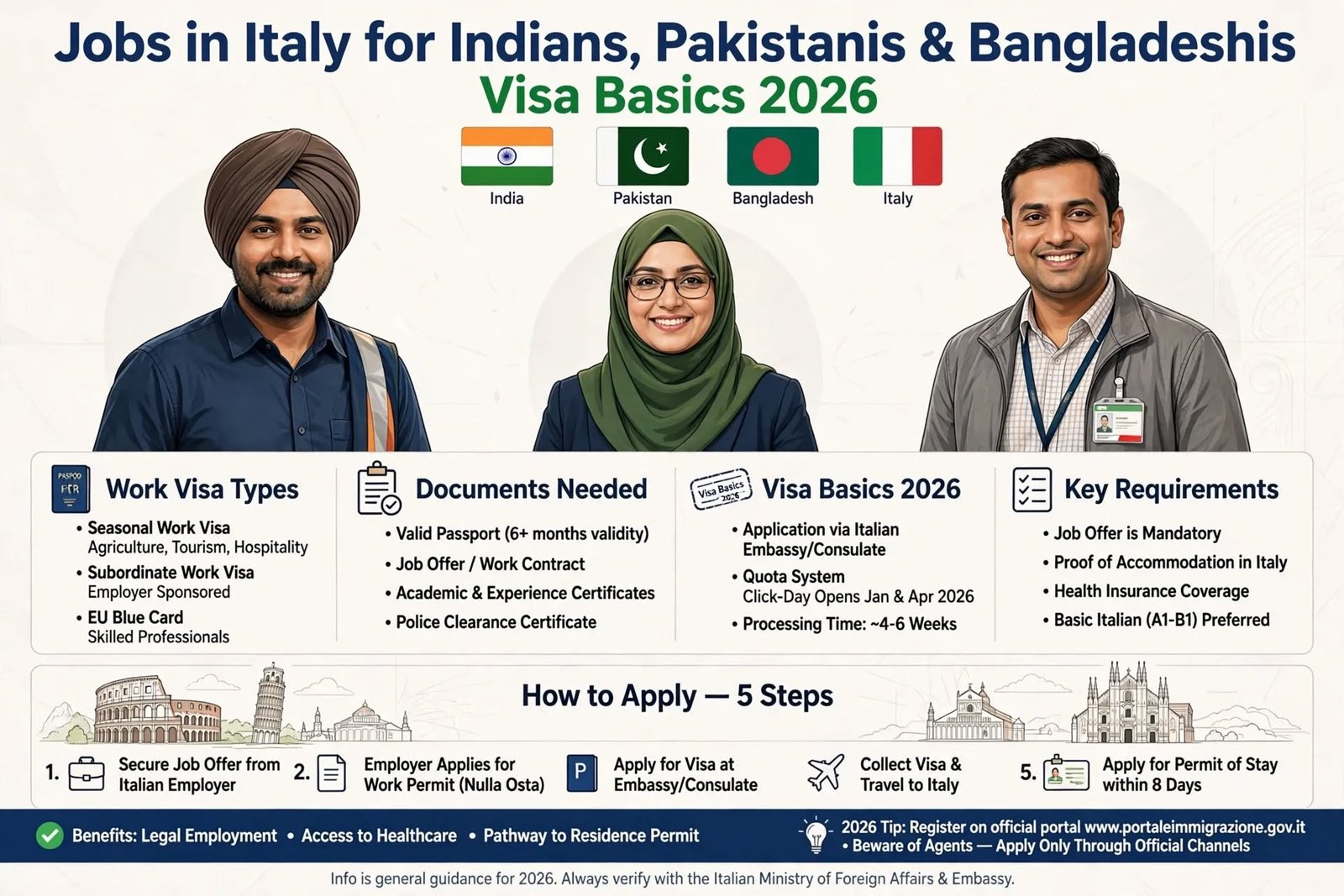
Every year, thousands of people from India, Pakistan and Bangladesh search for jobs in Italy. The reasons are easy to understand: Italy has labour shortages in farming, construction, hospitality, care work and manufacturing, and its wages and legal protections are far better than what many agents promise falsely elsewhere.
But there is a catch that most online posts skip: you cannot simply buy a ticket, land in Italy and look for work. For most non-EU citizens, the legal route starts with an Italian employer, a government quota, and a clearance document called the nulla osta. Fake agents exploit the confusion around this process, and many applicants lose money to false “guaranteed visa” offers.
This guide explains the visa basics in plain language: how the system works, who can apply, which routes exist, what the steps look like, and how to protect yourself. It is general information, not legal advice, and rules change, so always confirm details with official Italian sources before paying anyone.
How Working in Italy Legally Works: The Big Picture
Italy’s work-migration system has three main ingredients:
- A real job offer from an Italian employer (or a qualifying route that doesn’t need one).
- A quota slot under the annual immigration decree, called the Decreto Flussi, for most employed-work routes.
- A visa and residence permit, issued after the employer’s application is approved.
Notice what is missing from that list: a recruitment agency fee. The legal process is driven by the employer’s application, not by an agent selling visas.
What Is the Decreto Flussi?
The Decreto Flussi is Italy’s government decree that sets how many non-EU workers may enter the country for work. It also covers seasonal work, non-seasonal employed work and self-employment.
The current decree covers 2026 to 2028. It authorizes 497,550 non-EU work entries over three years, with 164,850 in 2026, 165,850 in 2027 and 166,850 in 2028. That is a large number, but demand from employers and applicants is much larger, so slots are competitive. migaku
The 2026 quota split in simple terms
For 2026, 88,000 quotas went to seasonal subordinate work in agriculture and tourism, and 76,200 went to non-seasonal employed work. Within the non-seasonal group, 13,600 quotas were reserved for family care and support workers. Smaller allocations exist for self-employment and special categories. eiglaweiglaw
What this means for you: most Indians, Pakistanis and Bangladeshis who find work in Italy through the standard route come in as seasonal workers (farming, tourism) or non-seasonal employees (construction, factories, logistics, care and similar roles).
The Click Day System Explained
Employers do not just submit applications whenever they like. They use a system called the click day.
- Pre-filling period: Employers fill in applications online in advance. For the 2026 round, pre-completion ran from October 23 to December 7, 2025. eiglaw
- Click day: On a fixed date and time, employers submit the application through the Ministry of the Interior’s online portal. For 2026, the dates were January 12 for agricultural seasonal work, February 9 for tourism seasonal work, February 16 for non-seasonal employees from countries with migration cooperation agreements, and February 18 for other non-seasonal employees. eiglaw
- Quota assignment: Quotas are shared among provinces according to the applications received.
Important for 2027: The same pattern is likely to repeat, with autumn pre-filling and click days early in the year, but you should confirm the official 2027 calendar on the Ministry of the Interior and Ministry of Labour websites. The government has also said it wants to gradually reduce the click day system and encourage entries outside the quota, especially for high-demand professions. Rules may therefore keep evolving. expatslivinginrome
Step-by-Step: The Standard Work Visa Process
Here is the typical sequence for an employed-work visa through the Decreto Flussi.
Step 1: An Italian employer decides to hire you
The employer must be a real, registered business or individual (for domestic work). They must show they can pay you properly and provide suitable housing arrangements where required.
Step 2: The employer applies for the nulla osta
During the pre-filling and click day windows, the employer submits the request for the nulla osta al lavoro, the work authorisation. This is the document that proves Italy has approved your hiring.
Step 3: Approval and signing the contract
If approved, the immigration office (Sportello Unico per l’Immigrazione) invites the employer and the worker to complete the process, including the contract of stay (contratto di soggiorno).
Step 4: You apply for the visa in your home country
With the nulla osta, you apply for the national (type D) work visa at the Italian embassy or visa centre in your country. Visa fees are modest, and one source lists €116 for an entry visa for subordinate work. That official fee is nothing like the thousands of dollars some agents demand. arlettipartners
Step 5: Travel and register in Italy
After arrival, you must apply for your permesso di soggiorno (residence permit) within eight days, usually through a post office kit and a police headquarters (Questura) appointment.
How long does it take?
One recent overview reports that end-to-end processing runs between two and six months. Delays are common, so avoid anyone who promises a visa “in 30 days.” migaku
Seasonal vs Non-Seasonal Work Visas
| Feature | Seasonal work | Non-seasonal work |
|---|---|---|
| Typical jobs | Harvesting, farm work, hotels, tourism | Construction, factories, logistics, care, trades |
| Duration | Short-term (typically months) | Longer, renewable permit |
| Path to long-term stay | Limited, but repeat seasonal entry is possible | Stronger path to renewal and settlement |
| Competition | Very high | Very high |
Seasonal work can be a realistic first step. Italy has quotas that favour workers who have previously worked there legally, which can make later seasons easier.
Routes That Don’t Depend on the Standard Quota
The click day is not the only door. Some routes sit outside the Decreto Flussi quota, and they are worth knowing about, especially for skilled applicants.
EU Blue Card
For higher-qualified professionals with a university degree and a qualifying job offer at a required salary level, the EU Blue Card is an option. One source notes that the EU Blue Card and intra-company transfers sit outside the Decreto Flussi quota. This route suits IT specialists, engineers and similar professionals. migaku
Intra-company transfer
If you already work for a multinational with an Italian branch, an intra-company transfer may be possible.
Study-to-work conversion
Many students from South Asia come to Italy on study visas and later convert to a work permit. This is a legitimate path, but it needs genuine enrolment, tuition planning and proof of funds. It is not a shortcut for people who only want to work.
Other special categories
Researchers, highly skilled workers, self-employed professionals and a few other groups have their own rules. If you fall in one of these, an official or lawyer-checked source is essential.
Does Nationality Matter? India, Pakistan and Bangladesh
Italy’s decrees often give reserved quotas or priority to nationals of countries that have migration cooperation agreements with Italy. For example, the 2026 round had a separate click day for non-seasonal employees who are nationals of countries with migration cooperation agreements. eiglaw
Citizens of India, Pakistan and Bangladesh have appeared in such lists in past decrees, but the list can change, and I could not confirm the exact current status for each country in the decree text. Check the annexes of the current decree or the Ministry of the Interior site for your nationality before assuming you qualify for a reserved quota.
Documents You Should Be Ready With
Requirements vary by visa type, but applicants commonly need:
- A valid passport (check the minimum validity)
- The nulla osta or work authorisation from Italy
- Signed employment contract or proof of job offer
- Passport-size photos meeting visa specifications
- Proof of accommodation in Italy
- Educational and professional certificates, often with translation and legalisation or apostille
- Police clearance certificate, where required
- Health insurance or proof of coverage as required for the visa type
- Visa application form and fee payment receipt
Bring originals and copies. Consulates may ask for more, so check the specific embassy page for your country.
Languages and Skills That Improve Your Chances
You don’t need perfect Italian to start, but learning basics makes you far more employable and safer at work.
- Basic Italian (even A1/A2) helps with contracts, safety instructions and daily life.
- Trade certificates matter for electricians, welders, plumbers and mechanics.
- Care-work training helps for family assistance and health-support roles.
- Driving experience and licence conversion can matter for transport roles, though foreign licences have their own rules.
- English plus IT skills help for tech and remote-friendly roles that may fit the Blue Card.
Common Scams and How to Avoid Them
The biggest danger in this topic is fraud. Watch for these red flags:
- “Guaranteed visa” promises. No agent can guarantee a government decision.
- Large upfront payments to a “recruiter” before any employer application exists.
- Fake job offers with no verifiable Italian company.
- Requests to pay in cash or through personal accounts.
- Offers to submit your name on click day for a fee, when the legal application must come from the employer.
- Pressure to decide fast or to keep the deal secret.
How to protect yourself:
- Ask for the employer’s full name, tax ID (partita IVA / codice fiscale) and verify they exist in Italy.
- Confirm the nulla osta through the official channel instead of trusting a PDF forwarded on WhatsApp.
- Never hand over your passport to an agent.
- Use official embassy and ministry websites for fees and forms.
- If something feels wrong, stop and ask an Italian immigration lawyer or your embassy.
Italy also fights undeclared work and worker exploitation, and the stated goal of the quota system is to channel hiring into legal, controlled routes. Working illegally on a tourist visa puts you at risk of deportation and entry bans.
What Jobs Are Realistically Available?
Based on how the quota system is structured, these sectors are the most common entry points:
- Agriculture: harvesting, greenhouse work, livestock and dairy
- Tourism and hospitality: hotels, kitchens, cleaning
- Construction and skilled trades
- Logistics and warehouse work
- Family and elderly care
- Manufacturing and food processing
Pay and conditions are set by Italian collective labour agreements (contratti collettivi), so a legal contract protects your minimum wage, working hours and social contributions. Always ask for the contract in writing, and have it translated before you sign.
Practical Tips for Applicants from South Asia
- Start early. Pre-filling windows are short, and employers need time to prepare.
- Build your profile. Keep an updated CV in English and, if possible, Italian.
- Search through legitimate channels. Italian job portals, verified employers, and reputable international recruiters who don’t charge workers illegal fees are safer than social-media “agents.”
- Prepare finances. Even with a job, you may need money for initial travel and settling in.
- Keep copies of everything. Contracts, receipts, applications and messages should be saved digitally and on paper.
- Learn your rights. Italian unions and local immigrant support offices can help if an employer breaks the contract.
Conclusion
Working in Italy from India, Pakistan or Bangladesh is possible, but it runs through a structured legal process: a real employer, a quota slot, a nulla osta, and then a visa. The Decreto Flussi 2026 to 2028 opens a large number of places, yet competition is intense and the rules around click days and nationality priorities keep changing. The safest strategy is to learn the process, build in-demand skills, verify every employer, and refuse anyone who sells a “guaranteed” visa.
If you remember only one thing, remember this: the employer applies, not an agent, and you should never pay for a promise.
Frequently Asked Questions (FAQ)
1. Can Indians, Pakistanis and Bangladeshis get a work visa for Italy?
Yes, if they have a legitimate job offer and the employer obtains a nulla osta, usually under the Decreto Flussi quota, or if they qualify for routes like the EU Blue Card.
2. Can I go to Italy on a tourist visa and find a job?
No. A tourist visa does not allow work, and you generally cannot convert it into a work permit inside Italy. You need the proper work authorisation first.
3. What is the Decreto Flussi?
It is Italy’s annual quota decree. The 2026 to 2028 version authorizes 497,550 non-EU work entries over three years. migaku
4. What is a click day?
It is the fixed date when employers submit online applications for work authorisations under the quota. In the 2026 round, dates ran from January through February.
5. How long does the process take?
Around two to six months is reported for the full process, but it can take longer depending on the province and documentation.
6. How much does an Italian work visa cost?
Official visa fees are modest. One source lists €116 for a subordinate work visa. Be careful with any agent charging far more, and check the embassy site for the current fee.
7. Is there a visa that doesn’t need the quota?
Yes. The EU Blue Card and intra-company transfers sit outside the quota and suit skilled professionals.
8. How do I know if a job offer is real?
Verify the company’s registration and tax ID, confirm the nulla osta through official channels, and never pay an agent before a legitimate employer application exists.
9. Do I need to speak Italian?
Not always for the visa, but basic Italian makes work safer and improves job prospects.
10. Where should I check official information?
Use the Italian Ministry of the Interior, Ministry of Labour, the Italian embassy or visa centre in your country, and the Ministry of Foreign Affairs visa portal.
Disclaimer: This article is for general information only and isn’t legal or immigration advice. Quotas, dates and nationality-specific rules change, so confirm everything with official Italian government sources.