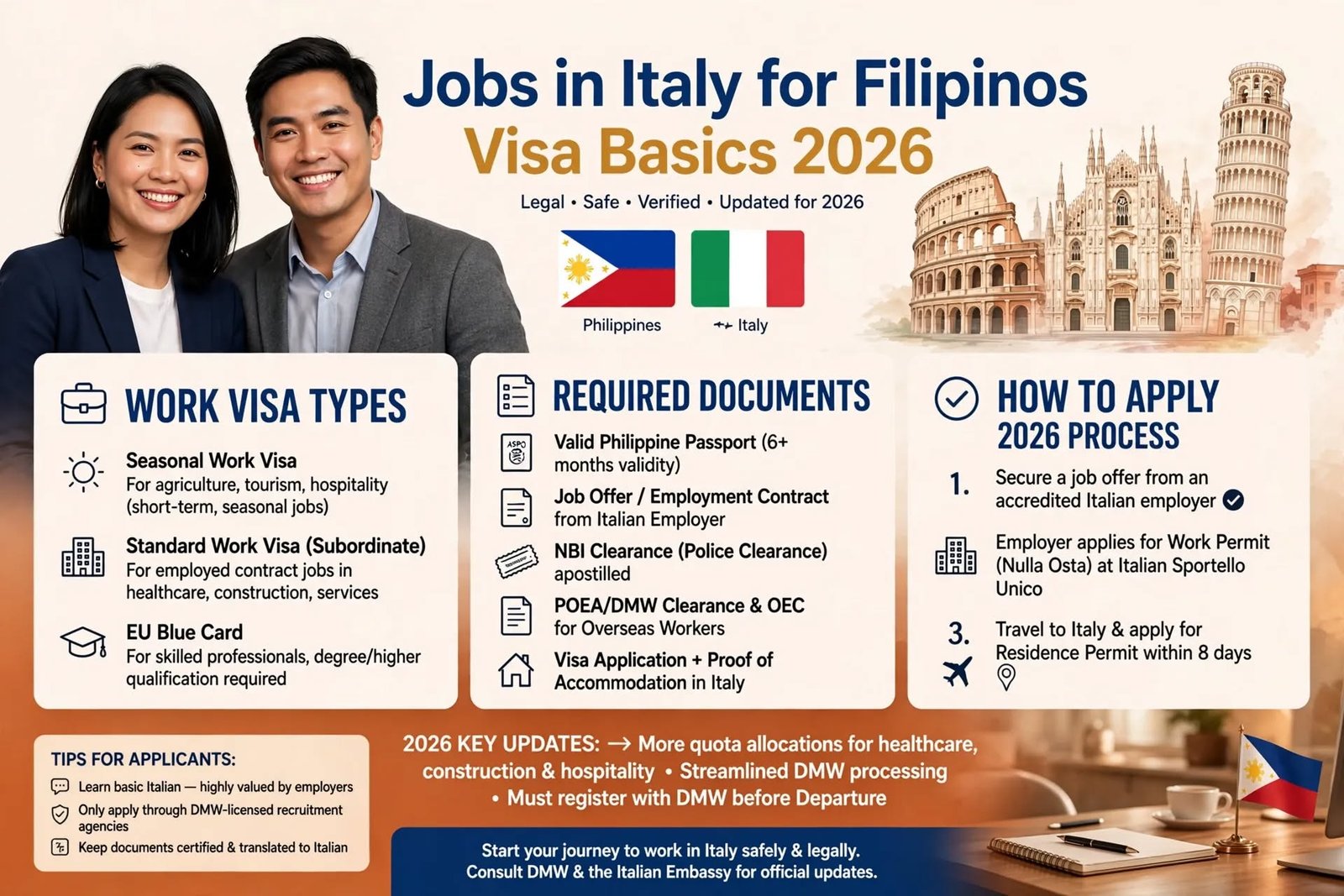
Italy has one of the oldest populations in Europe. Hospitals, farms, hotels, factories and thousands of households need workers, and the country cannot fill those roles from within. For many Filipinos, that gap is a real chance at a stable income and a better future.
The Filipino community in Italy is also one of the best established in Europe. Filipino caregivers, nurses, cooks and hospitality staff have worked there for decades, and many families back home still depend on their remittances.
Searching for jobs in Italy for Filipinos brings up a lot of noise, though, including fake job offers, agents who charge huge fees and confusing visa advice. This guide covers how the legal system works, which jobs are in demand, what you can realistically earn and how to protect yourself while applying.
Why Italy Is Attractive for Filipino Workers
Several things make Italy worth considering:
- Labour shortages: Care work, agriculture, construction, tourism and healthcare all struggle to find enough workers.
- Large Filipino community: Established networks in cities like Rome and Milan make settling in easier, from churches to community groups.
- Legal pathways: Italy runs a yearly quota system for non-EU workers, and the Philippines has been named among the countries Italy cooperates with on migration. Italy has bilateral migration agreements with 38 partner countries, the Philippines among them. workpermitguide
- Worker protections: Most jobs fall under national collective contracts that set minimum wages, paid leave and social security contributions.
- Path to long-term residence: After years of legal work, you can apply for a long-term residence permit, and family reunification may become possible.
Read Also: Jobs in Italy for Africans
How Filipinos Can Legally Work in Italy
Italy does not have a simple “job seeker visa” for Filipinos. In almost every case you need a specific Italian employer who offers you a contract and applies for authorization on your behalf. These are the main routes.
1. The Decreto Flussi (Annual Quota System)
The Decreto Flussi is Italy’s yearly quota system for non-EU workers. For 2026–2028, the quotas total 497,550: 164,850 for 2026, 165,850 for 2027 and 166,850 for 2028. confindustria
Here is how it works in practice:
- An Italian employer applies online for a work authorization called a nulla osta.
- Applications are submitted on specific “click days”, and slots can fill very fast. For 2026, separate dates were set for agricultural seasonal workers, tourism seasonal workers, and non-seasonal employees, including a dedicated day for nationals of countries with migration cooperation agreements. eiglaw
- If approved, you apply for the work visa at the Italian embassy or consulate in Manila.
- After arriving, you sign your residence contract and apply for your permit of stay (permesso di soggiorno).
Dates and quotas change each cycle, so always check the Italian Ministry of Interior or the Italian Embassy in Manila for the latest calendar.
2. Seasonal Work Permits
Seasonal jobs in farming and tourism are the most common entry point. The visa is temporary, but returning seasonal workers can sometimes get priority or multi-year arrangements later. One source notes that 1,500 of the 2026 seasonal slots were earmarked for nationals of recently added partner countries, the Philippines included. Always confirm the current figure with an official source. migaku
3. Family Care and Domestic Work
Elder care and household support are the classic Filipino niche in Italy. The 2026 quotas include 13,600 places specifically for family care and support services. Employers here are typically private families, so contracts usually follow the national domestic work agreement. eiglaw
4. Skilled and Professional Routes
Higher-skilled workers have other options:
- EU Blue Card: For university-educated professionals with a qualifying job offer and salary. It sits outside the Decreto Flussi quota. migaku
- Intra-company transfer: If your current employer has an Italian branch.
- Regulated professions (nurses, doctors, engineers): Your Philippine qualification must be recognized in Italy first, which takes time and paperwork.
5. Entries Outside the Quota
Some categories of workers can enter outside the quotas under Italy’s immigration law, or do not need the usual work permit. If you fit a special category, such as a highly qualified professional, ask an immigration lawyer to confirm. confindustria
In-Demand Jobs in Italy for Filipinos
Caregivers and Domestic Workers
This is the biggest sector for Filipinos. Duties include elderly care, cooking, cleaning and companionship. Live-in arrangements are common, which can reduce your living costs.
Nurses and Healthcare Assistants
Italy needs nurses, care assistants (OSS) and social care workers. Nurses must have their qualifications recognized by Italian authorities and usually need working-level Italian. It is a longer path, but with strong long-term prospects.
Hospitality and Tourism
Hotels, resorts and restaurants hire waiters, housekeeping staff, kitchen helpers and cooks, especially in summer and in tourist cities like Rome, Venice and Florence, and along the coast.
Agriculture and Farm Work
Harvesting fruit, vegetables, grapes and olives is physically demanding but offers one of the more direct routes in through the seasonal quota.
Construction and Skilled Trades
Electricians, plumbers, welders, carpenters and general construction workers are needed. Skilled trades with proof of experience have a stronger case with employers.
Logistics, Packing and Manufacturing
Warehouses, food-processing plants and factories hire for packing, machine operation and loading roles.
IT and Technical Roles
Software developers, data analysts and engineers can look at Blue Card routes or remote-first international companies, though competition is higher.
Salaries: What Can You Expect?
Italian pay depends on your sector, region and contract. Most employees are covered by a collective labour agreement (CCNL) that sets minimum pay, so you are rarely paid below the legal floor on a proper contract.
As a general guide only (always check the actual contract):
- Caregivers / domestic workers: Often modest monthly pay, but live-in roles may include room and board.
- Seasonal agricultural and hospitality workers: Paid by agreed hourly or monthly rates under the sector agreement.
- Nurses and healthcare staff: Higher, depending on public or private employer and experience.
- Skilled tradespeople and IT professionals: The highest earning potential, particularly in the north.
Remember Italian wages are usually quoted gross. Taxes and social contributions come out, and living costs are higher in Milan and Rome than in smaller towns and the south. Ask for a written contract that states hours, pay, accommodation and notice terms.
Step-by-Step: How to Apply for Jobs in Italy from the Philippines
- Choose your sector. Match your experience to a real shortage area (care, farming, hospitality, trades).
- Prepare your documents. Passport, CV, work certificates, training records and a police clearance. Documents often need translation and legalization or apostille, so start early.
- Find a genuine employer. Use verified channels, embassy resources and licensed recruiters, not social-media offers.
- Employer files the nulla osta. This is the employer’s job during the click-day window. You do not pay a stranger to “buy a slot.”
- Apply for the visa. Once the nulla osta is approved, you apply at the Italian visa office with your documents.
- Complete Philippine departure requirements. Filipino overseas workers generally must be processed through the Department of Migrant Workers (DMW), including the Overseas Employment Certificate. Check with DMW whether your hiring route requires an accredited agency.
- Travel and register in Italy. Within a few days of arrival, you complete your residence formalities and apply for your permit of stay.
Avoiding Scams: Protect Your Money
Fake job offers for Italy are widespread. Scammers reportedly charge between EUR 3,000 and 6,000 for fake job offers and sponsorship. Watch out for these red flags: workpermitguide
- Guaranteed visas or job slots for a fee.
- Pressure to pay quickly through personal accounts or e-wallets.
- No written contract, or a contract that differs from the offer.
- Recruiters who are not DMW-licensed or cannot be verified.
- Fake employer names with no real company address or website.
Before paying anything, verify the recruiter with DMW and, where possible, confirm the employer through official Italian channels. If you are unsure, ask the Philippine Overseas Labor Office or the Italian Embassy.
Language and Life in Italy
You can start work with basic Italian, but learning it pays off quickly. Even A2 level helps with employers, doctors, landlords and neighbors. Many Filipino workers take free or low-cost language classes after arrival.
Some practical points:
- Housing: Live-in work saves money, but rent in big cities can be steep.
- Healthcare: Legal workers can register with the national health system.
- Community: Filipino churches and associations offer support, advice and friendship.
- Food and culture: Italian life is family-centered, which many Filipinos find familiar.
Tips to Improve Your Chances
- Gather proof of experience. Certificates and references carry weight.
- Start Italian early. It shows commitment to employers.
- Stay current on quotas. Follow official announcements each year.
- Get documents ready ahead of time. Delays in apostilles and translations are a common cause of missed opportunities.
- Be patient. The process can take months, and rushing leads to mistakes or scams.
- Seek legal advice when unsure. A short consultation can save you thousands.
Conclusion
Jobs in Italy for Filipinos are real, but the path is a legal one: a genuine employer, a nulla osta under the Decreto Flussi or a skilled-worker route, a visa and proper processing through Philippine authorities. The sectors with the strongest demand are caregiving, healthcare, hospitality, agriculture and skilled trades.
Skip anyone promising shortcuts. Do your research, prepare your documents, learn some Italian and use only verified channels. With patience and the right information, working in Italy can become a rewarding long-term move.
Frequently Asked Questions (FAQ)
Can Filipinos get a job in Italy without a job offer?
In general, no. Most non-EU workers need an Italian employer to sponsor them, so a job offer is the starting point for almost every legal route.
How do I get a work visa for Italy from the Philippines?
Your employer applies for a nulla osta, and once approved you apply for a work visa at the Italian visa office. You also complete Philippine departure requirements through DMW.
What is the Decreto Flussi?
It is Italy’s quota decree that sets how many non-EU workers can enter each year for seasonal, non-seasonal and self-employed work.
What jobs are most common for Filipinos in Italy?
Caregiving and domestic work are the most common, followed by healthcare, hospitality, farm work and skilled trades.
Do I need to speak Italian?
Not always at the start, but it is a major advantage. Nurses and regulated professionals typically need stronger Italian.
How can I tell if a job offer is fake?
Warning signs include upfront fees for “guaranteed” visas, no written contract, unlicensed recruiters and pressure to pay immediately. Verify with DMW and official Italian sources.
Can I bring my family to Italy?
After you hold a valid permit and meet income and housing requirements, family reunification may be possible. Rules are specific, so check current requirements.
Is it possible to stay permanently?
Yes. After years of legal residence and meeting the conditions, you may qualify for a long-term residence permit.
Disclaimer: Immigration rules, quotas and click-day dates change often. Always confirm current requirements with the Italian Embassy in Manila, the Italian Ministry of Interior and the Philippine DMW before applying.